
Last Updated: November 14, 2026
Quick Summary
Land clearing for residential development is the controlled removal of trees, brush, stumps, and rock from a building site so construction can begin on solid, level ground. Forestry mulching is the best method for most wooded residential lots, and permits, erosion control, and grading should be planned before any equipment arrives.
- A 2023 study found 49% of canopy cover was cleared during greenfield residential development.
- Call 811 before digging to locate buried utility lines on the lot.
- Forestry mulching grinds brush and saplings into mulch on site, skipping hauling costs.
- Confirm zoning, overlay districts, HOA covenants, and setbacks before flagging trees for removal.
- Strip and stockpile topsoil during grading so good material is available for later landscaping.
Table of Contents
- Why Land Clearing Sets the Tone for Your Entire Build
- Site Assessment and Surveying Before You Clear a Single Tree
- The Best Way to Clear Land With Trees on a Residential Lot
- Land Clearing Permits and Local Rules You Need to Know
- How Long Does It Take to Clear an Acre of Land With an Excavator?
- Grading Land for Construction After the Trees Are Gone
- Soil Health, Erosion Control, and Debris Management That Protect Your Lot
- Get a Free Land Clearing Estimate From Davis & Company
- Frequently Asked Questions
Why Land Clearing Sets the Tone for Your Entire Build
Land clearing for residential development is the controlled removal of trees, brush, stumps, and rock from a building site so construction can begin on solid, level ground. Get it right, and every later stage runs smoother.
The stakes are bigger than most people expect. A 2023 study summarized by ScienceDirect research on greenfield residential development found that 49% of canopy cover was cleared during residential development.
Davis & Company is a family-owned business serving Mid-Michigan since 2015. The clearing phase largely decides how your lot drains, how your foundation sits, and how much site work you pay for later.
Below, we break down each step, from the first survey to final grading.
Site Assessment and Surveying Before You Clear a Single Tree
A site assessment is a walkthrough and survey of your lot that maps trees, slopes, water flow, and access points before any equipment arrives. Skipping it is the most common mistake we see.
Start with these checks:
- Boundary lines. Confirm exactly where your property ends. Clearing a neighbor’s trees is an expensive error.
- Topography. Note the high and low spots. Water tells you where your driveway and foundation should go.
- Tree health. Healthy, mature trees add value. Diseased or leaning trees near the build zone should go.
- Access. Can a truck and excavator reach the site? Tight access changes the plan and the schedule.
- Utilities. Call 811 before digging (811 Before You Dig). Buried lines are not something to guess at.
A proper land survey and site assessment protects you from much larger problems later.
The Best Way to Clear Land With Trees on a Residential Lot
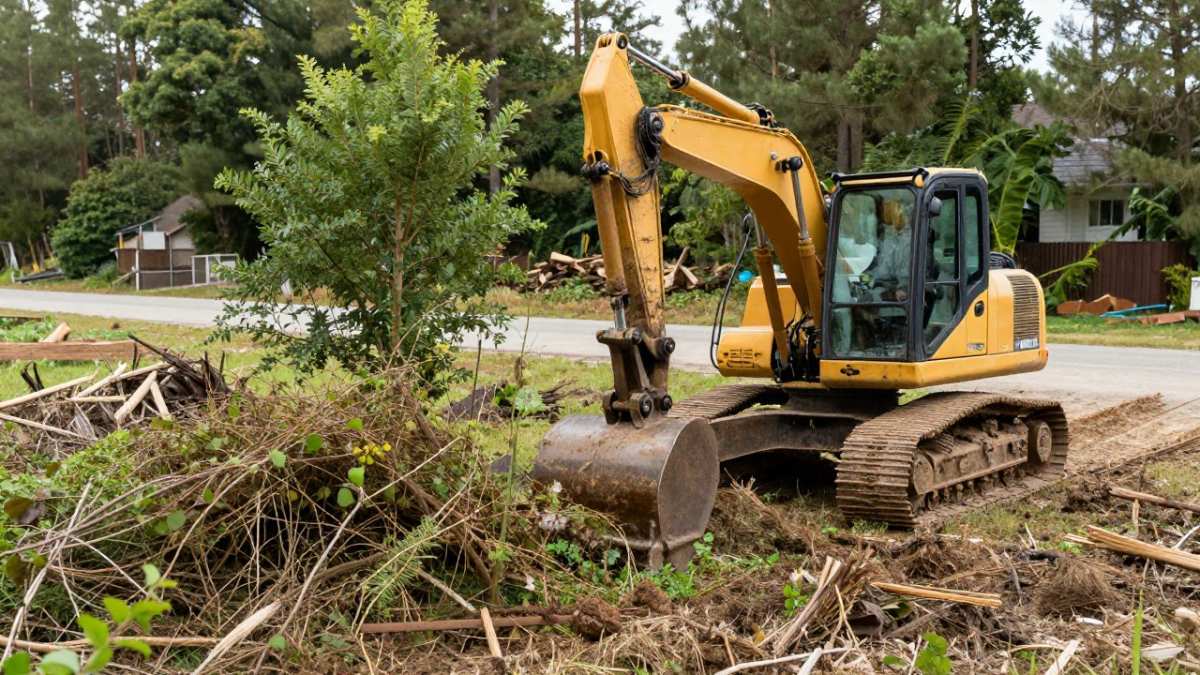
The best way to clear land with trees on a residential lot is forestry mulching for most wooded sites. A machine grinds brush, saplings, and small trees into mulch on the spot, leaving no burn piles and no hauling.
Here is how the main methods compare:
| Method | Best For | What Happens to Debris |
|---|---|---|
| Forestry mulching | Brush, saplings, dense undergrowth | Ground into mulch on site |
| Bulldozing | Large trees, heavy root systems | Pushed into piles, then hauled or burned |
| Excavator clearing | Stumps, mixed lots, tight access | Loaded out or buried per plan |
| Hand clearing | Small lots, trees you want to keep | Cut and hauled away |
Forestry mulching leaves the soil mostly intact and skips the hauling cost. On lots with big hardwoods or stumps, an excavator does the heavier work. Many projects need both. Davis & Company offers forestry mulching in Mid-Michigan for treed lots where hauling would slow the job down.
Land Clearing Permits and Local Rules You Need to Know
Land clearing permits depend on your town, county, and the size of the project. Call your local building department before any equipment shows up, and treat the permit step as a gate, not a formality, a missing approval can halt the job mid-cut.
Rules vary widely. Some counties require a permit for any clearing above a set area. Others focus on erosion control plans and tree preservation.
Ask these questions early:
- Does my project need a land clearing permit, and what is the trigger (acreage, tree count, proximity to water)?
- Is an erosion control plan required, and who signs off on it?
- Are there protected trees, heritage trees, or wetland buffers on the lot?
- Does my HOA have rules about tree removal, lot appearance, or approved contractors?
- Are there tree replacement or mitigation requirements if I remove mature canopy?
Get answers in writing. A permit delay can push your whole build back, and fines for unpermitted clearing add up fast.
Zoning, Overlay Districts, and Setbacks
Zoning is the first filter. A residential lot may sit in a district with minimum lot coverage, front/side/rear setbacks, and buffer requirements that dictate where you can and cannot clear. Overlay districts, floodplain, watershed, coastal, or scenic corridor, add another layer.
Setbacks matter more than most owners expect. You may own the tree, but if it sits in a required buffer or setback, removing it can trigger a violation. A common pattern is a lot that looks clearable on paper but loses a third of its buildable area once buffers and setbacks are drawn.
HOA and Restrictive Covenants
Homeowners associations and deed restrictions are private rules that run with the land, and they can be stricter than the town. Typical covenants limit tree removal, require architectural review before clearing, set minimum green space, or ban burning of debris. Some require you to submit a site plan and get written approval before any equipment enters. Read the covenants, not just the bylaws, and get HOA approval in writing before the first cut. A dispute with an HOA can cost more in delays than the clearing itself.
Erosion Control and Tree Preservation Plans
Many jurisdictions require an erosion and sediment control plan as part of the clearing permit. Expect to show silt fence locations, stabilized construction entrances, and where disturbed soil will be seeded or covered. Tree preservation plans are increasingly common: you mark the trees to keep, fence the root protection zones, and document the canopy you remove. If your town requires mitigation, you may need to replant a set number of trees or pay into a tree fund.
Watch out: starting work on the assumption that “it’s my land” is the most expensive permit mistake, unpermitted clearing can bring stop-work orders, fines, and required replanting before you ever pour a foundation.
A Practical Permit Sequence
- Pull the zoning and overlay maps for the parcel.
- Read the HOA covenants and architectural review rules.
- Call the local building department and ask what triggers a clearing permit.
- Confirm erosion control and tree preservation requirements.
- Submit the site plan and get approvals in writing.
- Post required signage and install erosion controls before equipment arrives.
Working through this sequence early helps make sure the plan matches what the town and the HOA will actually approve.
How Long Does It Take to Clear an Acre of Land With an Excavator?
How long clearing takes depends on the lot, including tree density, stumps, and wet ground, so ask for a written timeline after the site assessment.
Several things move the timeline:
- Tree density and size. Open brush goes fast. Mature hardwoods with deep stumps do not.
- Stump removal. Grinding or pulling stumps is often the slowest part.
- Site access. If equipment cannot reach the back of the lot easily, everything slows.
- Debris disposal. Hauling debris off site adds days. Mulching in place saves them.
- Weather. Wet spring ground can stop heavy equipment entirely.
Plan for the job to take as long as the site requires, and treat any single-day promise for a heavily wooded acre with caution.
Grading Land for Construction After the Trees Are Gone
Grading is the process of shaping the soil so water drains away from the house and the lot sits level for construction. Rough grading comes right after clearing.
Here is the order we follow:
- Remove stumps and root balls from the build pad.
- Strip and stockpile topsoil for later landscaping.
- Cut and fill soil to reach the target grade.
- Compact the soil in layers.
- Shape the slope so water runs away from the foundation.
Good grading is invisible when it is done. Bad grading shows up as a wet basement or a soggy yard. For a fuller walkthrough of what happens between clearing and building, see our guide on how to prepare land for construction.
Soil Health, Erosion Control, and Debris Management That Protect Your Lot
Clearing exposes bare soil, and bare soil washes away. Erosion control and debris management are the two jobs most homeowners underestimate, and the two that most guides skip past. This section goes deeper than the standard checklist: how to stabilize soil before construction, how to decide what to do with the debris, and how to keep the trees and native plants worth saving.
Stabilizing Soil After Clearing
The goal is to keep exposed soil covered and slow the water down. A practical sequence:
- Silt fence around the disturbed area perimeter, keyed into the ground, not just staked on top.
- Straw or mulch on exposed slopes, applied heavy enough to stay put in rain.
- Stabilized construction entrance so trucks do not track mud onto the road.
- Check dams or swales where water concentrates, to drop sediment before it leaves the site.
- Seeding or hydroseeding once rough grading is done, with a temporary cover crop if final landscaping is months away.
Soil compaction matters too. Heavy equipment presses the air out of soil, which can starve roots and cause drainage problems. Keep equipment off areas you plan to landscape, or plan to aerate and amend the soil afterward. Stockpile topsoil separately during grading so you have good material to spread back over the finish grade.
Debris Management: Mulch, Haul, or Burn
You have three options, and each has a real trade-off:
| Option | Best For | Trade-offs |
|---|---|---|
| Mulch in place | Brush, saplings, undergrowth | Cheapest and fastest; mulch ties up nitrogen as it breaks down, so keep it out of the immediate planting beds or plan to amend |
| Haul away | Large trees, stumps, mixed debris | Cleanest finished lot; adds trucking cost and schedule time |
| Burn | Woody debris where allowed | Low hauling cost; needs a permit in most places, depends on season and burn bans, and smoke can draw complaints |
Mulching is usually the cheapest and fastest. Hauling is cleanest. Burning needs a permit in most places and depends on the season. A common pattern is to mulch the undergrowth, haul the merchantable timber if it has value, and burn or chip the rest, but check local rules before you light anything.
Preserving Native Vegetation and Mature Trees
Clearing does not have to mean bare ground. Selective preservation keeps the trees that add value and shade while removing what is in the way of the build.
- Mark the keepers first. Flag mature, healthy trees and native plant clusters before equipment arrives, and fence the root protection zone at the drip line.
- Protect the root zone. Compaction inside the drip line can kill a tree slowly over years; keep equipment and stockpiles outside it.
- Work around the canopy. Directional felling and hand clearing near keepers cost more but save trees that would otherwise be damaged.
- Replant with natives. Native grasses and shrubs stabilize soil and need less water and maintenance than a bare lawn.
Watch out: preserving a tree but driving over its root zone is the most common way owners lose the trees they paid to save, the damage shows up two or three seasons later, long after the contractor is gone.
Planning erosion control, debris handling, and tree preservation together helps the finished site stay stable, clean, and ready for the next stage. Our guide on grading for property drainage explains how slope protects your lot long term.
Get a Free Land Clearing Estimate From Davis & Company
Every lot is different, so every clearing plan should be too. The right approach depends on your trees, your soil, your timeline, and your budget.
Davis & Company is family-owned and has served Mid-Michigan property owners since 2015. The business offers clearing, grading, excavation, driveways, landscaping, and snow removal, so one team can cover a whole project.
If you are ready to clear your lot and start building, contact us for a free estimate on land clearing, grading, and site prep.
Clearing a residential lot is a big decision, and the wrong crew can cost you time and money.
Frequently Asked Questions
Do I need a permit to clear land on my property?
In most cases, yes. Land clearing permits are typically required when you remove trees, change drainage, or disturb soil above a certain threshold, and the rules vary by county and township. Before any equipment arrives, check with your local planning or building department and ask about zoning ordinances, tree preservation rules, and erosion control requirements. Skipping this step can lead to stop-work orders or fines that cost far more than the permit itself. A professional land clearing contractor can usually tell you which approvals apply to your lot.
What is the best way to clear land with trees?
The best way to clear land with trees depends on tree size, density, and what you plan to build. Forestry mulching works well for brush and small trees because it grinds vegetation in place and leaves a protective layer on the soil. Bulldozing with root raking suits larger trees and full site clearing. On lots with mature hardwoods or trees you want to keep, a selective approach that protects the root zones of remaining trees is often smarter than clearing everything. A site assessment should decide the method, not a one-size-fits-all rule.
How long does it take to clear an acre of land with an excavator?
There is no single answer, because time depends on tree size, density, stumps, soil conditions, and site accessibility. A lightly wooded acre with brush and small trees may take a day or two with the right equipment, while a heavily wooded acre with large stumps and hauling needs can take several days. Weather, permit conditions, and debris disposal also affect the schedule. Ask your contractor for a written timeline after the site assessment, and expect the estimate to account for stump removal and grading, not just cutting.
What should be done before clearing a residential lot?
Before clearing, confirm property lines with a land survey, review zoning ordinances and HOA rules, secure any required permits, and mark trees or features you want to preserve. Identify utility lines and call 811 so underground services are located. Plan where debris will go and how erosion control will be installed. A site assessment covering topography, drainage, and soil conditions should come first. Doing this groundwork prevents rework, protects your neighbors’ property, and keeps the project on schedule once equipment arrives.
