
Last Updated: October 28, 2026
Quick Summary
To prepare land for construction, start with a site evaluation, topographic survey, and soil testing to check bearing capacity, then confirm zoning, permits, and building placement before any clearing. Next, clear trees and debris, grade the lot for drainage, and bring in access and utilities. Site preparation cost depends on the land, not a flat rate.
- Building on untested soil is the most expensive shortcut in site prep.
- Zoning setbacks, lot coverage limits, and permits must be confirmed before clearing.
- Forestry mulching grinds brush in place with less hauling than conventional clearing.
- Land clearing runs roughly $1,500 to $6,000 per acre for light brush.
- A geotechnical soil borings report typically costs a few thousand dollars.
Table of Contents
- Start With a Site Evaluation and Topographic Survey
- Confirm Zoning, Permits, and Building Placement
- Land Clearing for Construction: Trees, Brush, and Demolition
- Land Grading for Construction and Drainage Control
- What Drives Site Preparation Cost
- Your Construction Site Preparation Checklist
- Frequently Asked Questions
Start With a Site Evaluation and Topographic Survey
Learning how to prepare land for construction starts with a hard look at what you own. Walk the lot before you dig it.
What a Site Survey and Soil Testing Reveal
A topographic survey maps the highs and lows of your lot, showing where water runs and where a building pad can sit without major earthwork.
Soil testing goes deeper. A geotechnical assessment uses boreholes to check bearing capacity, how much weight the ground can hold. Weak soil means a bigger foundation; wet soil means drainage work first.
Building on untested soil is the most expensive shortcut in site prep, poor bearing capacity can force foundation redesigns or full removal of finished work.
Confirm Zoning, Permits, and Building Placement
Zoning requirements and building permits come before any clearing. Your local planning office sets setbacks, lot coverage limits, and allowed uses. Pull the rules first, then draw the site plan.
Building placement follows the survey. Put the structure where the ground is stable, the slope is workable, and access makes sense, leaving room for a driveway, utilities, and drainage swales.
Check these before you break ground:
- Zoning setbacks and lot coverage limits
- Building permit requirements and inspection schedules
- Utility easements crossing the lot
- Floodplain or wetland restrictions
- Driveway and access point approvals
For a deeper walkthrough, our contractor’s excavation prep checklist covers what to have ready before machines arrive.
Land Clearing for Construction: Trees, Brush, and Demolition
Land clearing for construction means removing trees, brush, stumps, debris, and any structures in the way.
Three common approaches:
- Conventional clearing: trees cut and hauled off site. Clean result, higher hauling cost.
- Forestry mulching: brush and small trees ground in place. Less hauling, faster on dense lots. See how forestry mulching handles brush and vegetation on your lot.
- Demolition: existing buildings, fences, and slabs removed before grading.
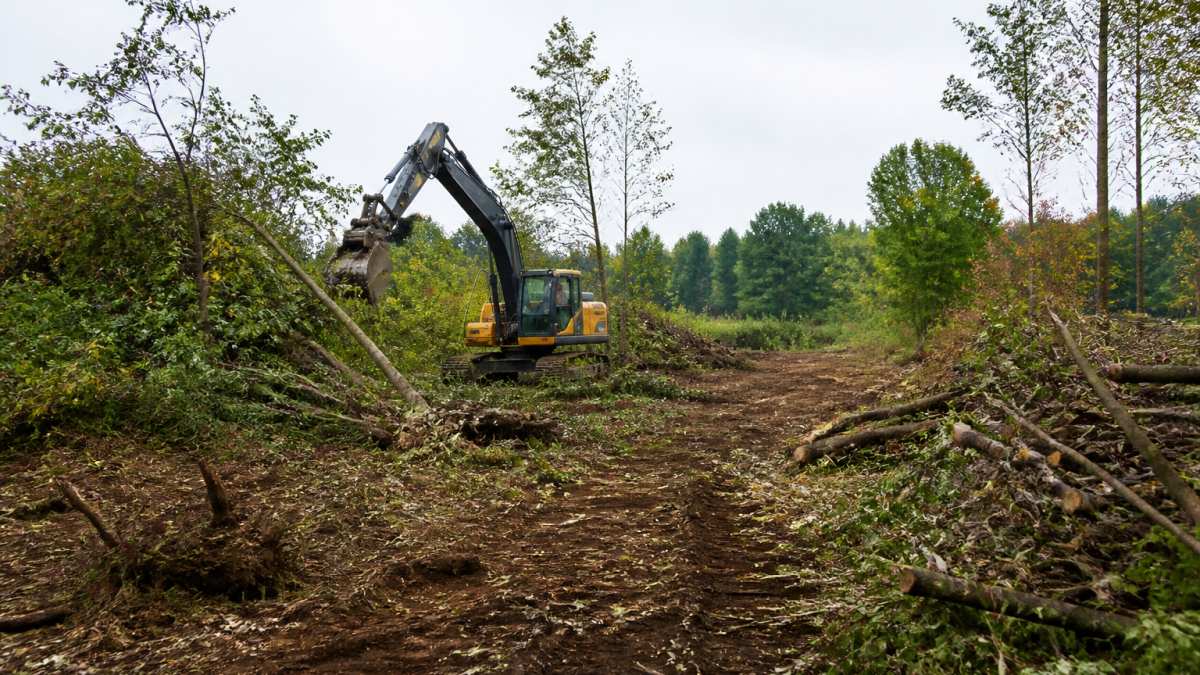
If you want the clearing handled on your own site, our land clearing service covers residential, agricultural, and commercial lots.
Land Grading for Construction and Drainage Control
Grading shapes the ground so water moves away from the building. For site prep and driveway grading in Perry and Mid-Michigan, a local contractor can handle the earthwork.
The Grading Sequence and What Each Stage Decides
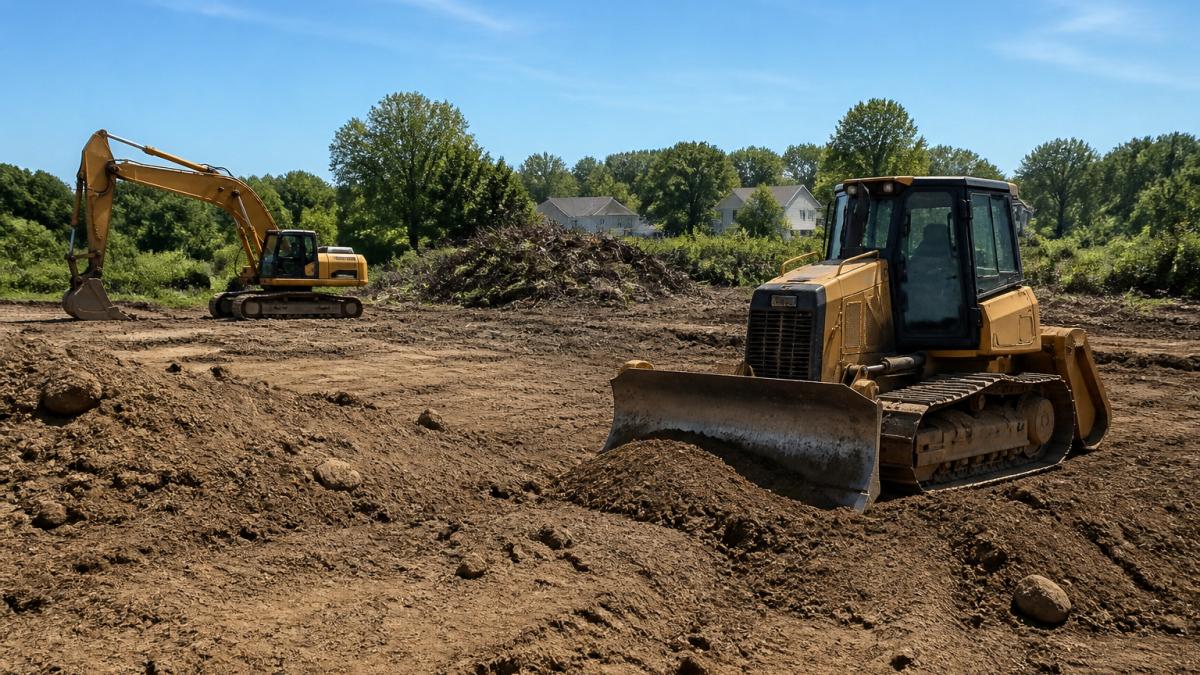
A common pattern: rough-grade the whole lot but fine-grade only the building pad and drainage path, keeping earthwork cost proportional to what the foundation needs.
Drainage, Erosion, and Stormwater Controls That Actually Work
Stormwater rules vary by jurisdiction, and larger disturbances often trigger a state-issued construction stormwater permit with a required erosion and sediment control plan. Check your lot’s threshold before grading; retrofitting controls after a complaint costs far more than installing them up front.
What a Build-Ready Pad Looks Like
Get this wrong and water pools at the slab edge, showing up as a wet basement or cracked slab a season later, when the fix is excavation, not a service call.
What Drives Site Preparation Cost
Site preparation cost depends on the land, not a flat rate. Two lots the same size can price very differently. The big drivers:
- Clearing volume: dense trees and brush cost more than open field
- Soil conditions: weak or wet soil means more earthwork
- Slope: steep ground needs cut and fill
- Drainage work: swales, culverts, and retention add scope
- Utility distance: long runs to power or water add cost
- Access: remote or tight lots slow equipment down
Budget Ranges and How to Read Them
Published ranges are a starting point, not a quote. Most contractors price by the task, and the same task can land at either end depending on access and soil. Typical residential site-prep line items:
- Land clearing: roughly $1,500 to $6,000 per acre for light brush and small trees; dense hardwood or heavy demolition pushes well above that.
- Grading and earthwork: commonly $1,000 to $4,000 per acre for light grading; cut-and-fill on sloped ground or import/export of soil adds significantly.
- Driveway and access: a gravel construction entrance or temporary drive often runs $2,000 to $8,000 depending on length and base depth.
- Septic perc test and design: a perc test alone is often a few hundred dollars; full septic design and permitting runs higher.
- Utility extension: trenching and service runs are priced per foot, and pole extensions or long rural runs are the line item most likely to surprise a landowner.
- Geotechnical assessment: a soil borings report is typically a few thousand dollars and is the cheapest insurance on the list.
Cost Drivers in Plain Terms
Utilities are priced by distance and approval. A lot near the road with municipal water and power at the pole is cheap to connect. A remote lot needing a pole extension, well, and septic system carries infrastructure costs that can rival the clearing budget.
Contingency and the Surprises That Blow the Budget
We give free estimates and offer flexible financing for larger projects. You can contact us to request a free estimate.
Your Construction Site Preparation Checklist
Use this checklist to track site readiness from first walk to final grade.
| Step | What It Covers | Done When |
|---|---|---|
| Site evaluation | Walk the lot, note slope and drainage | Conditions documented |
| Survey and soil test | Boundaries, topography, bearing capacity | Report in hand |
| Zoning and permits | Setbacks, lot coverage, approvals | Permits issued |
| Site plan | Building placement and layout | Plan approved |
| Land clearing | Trees, brush, debris, demolition | Footprint and access open |
| Grading and drainage | Rough grade, swales, erosion control | Water flows away from pad |
| Access and utilities | Entry point, water, power, septic | Connections feasible |
| Foundation prep | Compacted, level pad at elevation | Pad inspected |
Frequently Asked Questions
How long does it take to prepare land for construction?
Timelines vary with lot size, vegetation, and permitting. Weather, soil conditions, and utility scheduling add time.
Do I need a survey before clearing or grading land?
Yes. A boundary and topographic survey marks property lines and shows slope, drainage patterns, and existing features. Clearing or grading without one risks cutting a neighbor’s trees, building over an easement, or grading water toward your foundation. Most jurisdictions also require a sealed site plan with permit applications. Have the survey done first, then use it to plan building placement, access points, and where runoff will go before any equipment moves onto the lot.
What drives site preparation cost?
Site preparation cost depends on acreage, tree and brush density, how much earthwork is needed, soil conditions, and how far utilities must run. Steep slopes, rock, and wetlands raise the price because they need extra engineering or fill. Access matters too: a lot without a usable entrance needs a culvert or driveway base built first. Get an itemized estimate that separates clearing, grading, drainage, and utility trenching so you can compare bids and budget for contingencies.
How do I know if land is suitable for building?
Check zoning, setbacks, floodplain maps, and whether water and septic or sewer service are feasible.
Preparing land for construction rewards patience and punishes shortcuts. If you own raw land in Mid-Michigan and want it build-ready, Davis & Company handles land clearing, grading, drainage, and pad construction as one family-owned team, with free estimates and flexible financing. Get started with Davis & Company and turn your lot into a site you can build on.
