
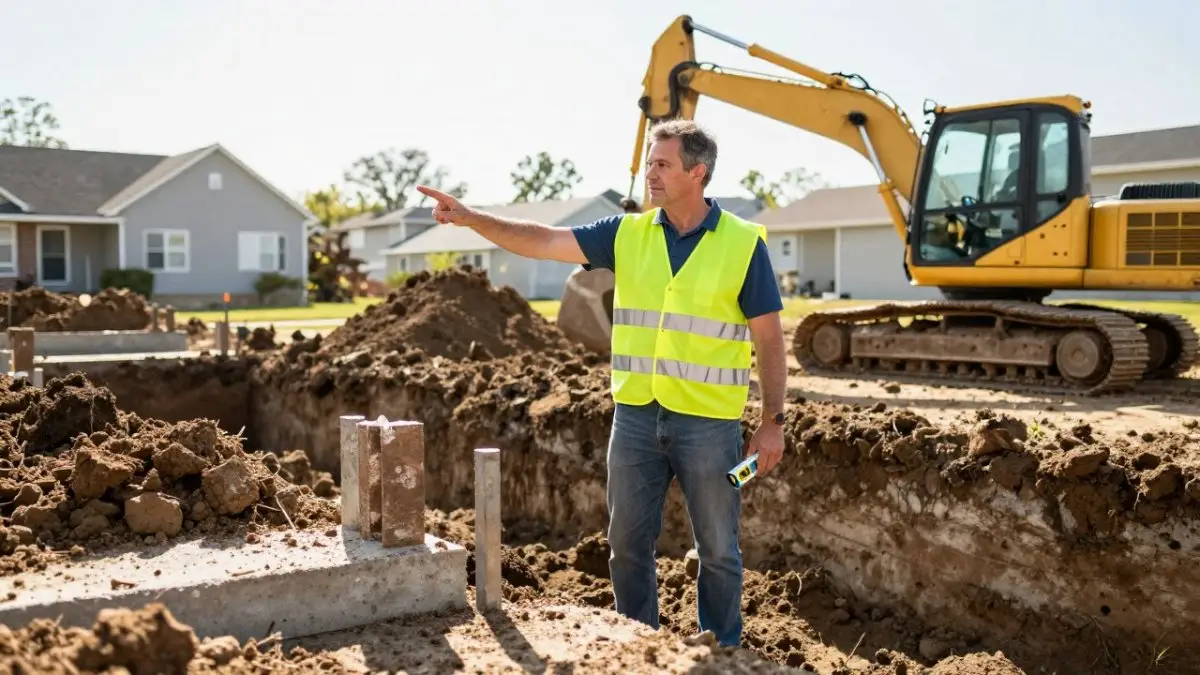
Last Updated: November 11, 2026
Quick Summary
To hire an excavation contractor for house foundation work, verify licensing and insurance, request three references from similar residential foundation projects, and get written terms for permits, utility locating, rock removal, and payment tied to milestones. The best contractor combines local soil experience, clear communication, and detailed line-item estimates.
- Site prep, utility marking, and soil evaluation come before any digging begins.
- Excavation typically takes 2-5 days, with footings and inspection adding 3-7 days.
- Ask how rock removal is priced: per cubic yard, hourly, or a flat allowance.
- Tie progress payments to milestones like excavation complete and footings poured, not calendar dates.
- Score contractors 1 to 5 on weighted criteria, using communication as the tiebreaker.
Table of Contents
- What an Excavation Contractor Does for a House Foundation
- House Foundation Excavation Timeline: What to Expect Week by Week
- Foundation Excavation Contractor Questions to Ask Before You Sign
- Your Foundation Excavation Contract Checklist
- How to Identify the Best Excavation Contractor for House Foundation Projects
- Get a Free Estimate from Davis & Company
- Frequently Asked Questions
What an Excavation Contractor Does for a House Foundation
An excavation contractor for house foundation work handles the digging, grading, and site prep that lets a foundation be built correctly. According to IBISWorld’s excavation contractor market data, U.S. excavation contractors make up a $145.7 billion market in 2026. At Davis & Company, we’ve handled this kind of work across Mid-Michigan since 2015, and the job always starts the same way: understanding the ground before anyone digs.
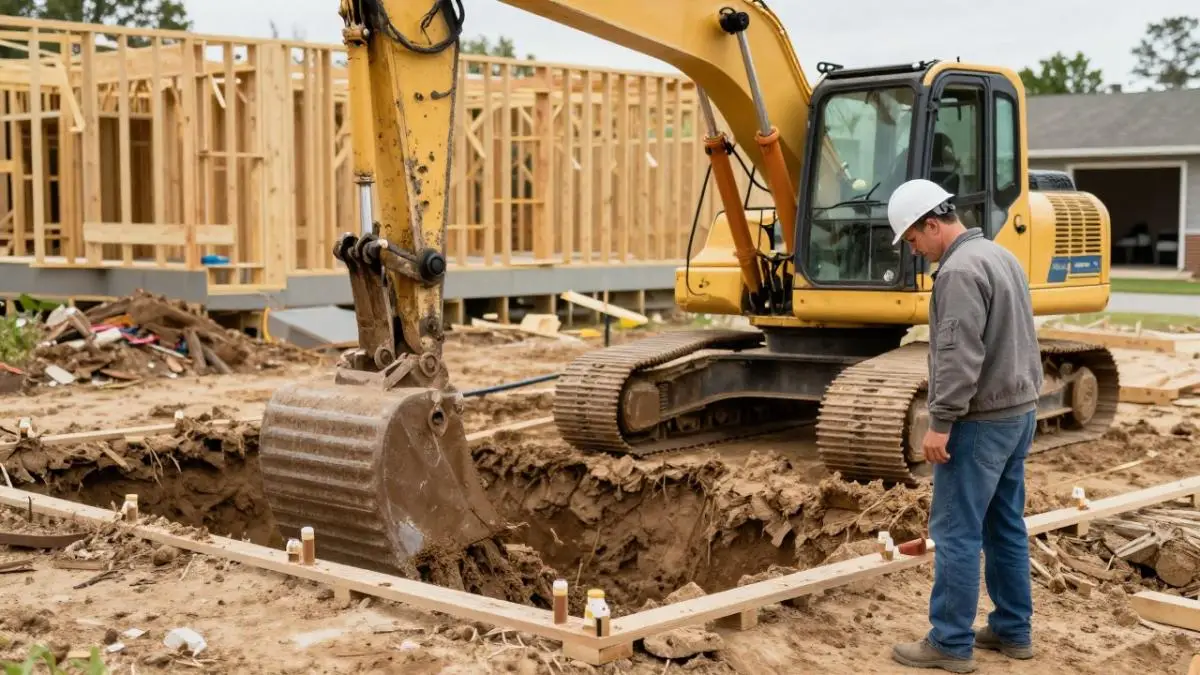
Site Preparation and Soil Evaluation
Site preparation is the step where a house foundation is either set up to last or set up to fail. The contractor clears the lot, marks utility lines, and studies the soil to see how it drains and how much weight it can bear. Contractors in the U.S. work within a construction industry of more than 919,000 establishments, per Associated General Contractors of America data, so experience and local knowledge matter when you’re picking one.
Footings, Pouring, and Waterproofing Coordination
Footings are the wide concrete pads that carry the weight of the foundation walls down into stable soil. The excavation contractor digs trenches to the right depth and width for those footings, then coordinates with the concrete crew so the pour happens on schedule. Waterproofing and drainage come next: without proper grading and drainage around the foundation, water pools against the walls and causes the cracks and settlement problems that lead to foundation repair later.
House Foundation Excavation Timeline: What to Expect Week by Week
Soil conditions and weather can affect how long a house foundation excavation takes. Here’s the general sequence we walk homeowners through:
| Phase | What Happens | Typical Timing |
|---|---|---|
| Permits and utility locating | Permits pulled, utilities marked | 1-2 weeks before digging |
| Site prep and clearing | Lot cleared, access created | 1-3 days |
| Excavation | Hole dug to grade, soil stockpiled | 2-5 days |
| Footings and inspection | Footing trenches dug, inspected, poured | 3-7 days |
| Foundation walls | Walls formed and poured or block laid | 1-2 weeks |
| Waterproofing and backfill | Drainage installed, hole backfilled | 2-4 days |
For a deeper walkthrough of methods, equipment, permits, and timelines, see our complete guide to excavation.
Foundation Excavation Contractor Questions to Ask Before You Sign
Ask any excavation contractor for house foundation work these questions before signing, and listen for specifics rather than reassurances.
Are you licensed and insured, and can I see the certificates? Ask for the certificate of insurance naming general liability and workers’ compensation, and call the carrier to confirm it is current.
Can you provide references from similar residential foundation projects? Ask for three references from the last two years on projects with comparable lot size, slope, and soil. Then ask those homeowners two things: did the contractor hit the dates in the contract, and did the final invoice match the estimate?
Who handles permits and utility locating? Ask who pulls the excavation and foundation permits and who requests the utility locate before any digging.
What happens if we hit rock, groundwater, or bad soil? This is the question that separates experienced foundation excavators from general diggers.
How do you protect the excavation and who is responsible for damage? Ask about slope protection, shoring for deep digs, and fencing or barricades around the open hole. Our guide on avoiding contractor disputes walks through how to put those protections in place from day one.
What is your payment schedule and warranty? Progress payments are best tied to milestones (excavation complete, footings poured, backfill done), not to calendar dates.
A contractor who answers these with specifics, in writing, is the one to shortlist.
Your Foundation Excavation Contract Checklist
Use this checklist when reviewing a foundation excavation contract:
- Written scope of work with dimensions and depths
- Start and completion dates
- Payment schedule tied to milestones, not just a deposit
- Proof of insurance and licensing
- Who pulls permits and handles inspections
- Utility locating responsibility stated clearly
- Change order process in writing
- Cleanup and soil disposal terms
- Warranty or workmanship guarantee
Before the crew arrives, our excavation prep checklist covers how to get your site ready and avoid delays.
How to Identify the Best Excavation Contractor for House Foundation Projects
The best excavation contractor for house foundation work combines local experience, clear communication, and proof of insurance. Start with referrals from neighbors and local builders, then verify each candidate against the criteria below. Check customer reviews and ratings, confirm their service area covers your property, and ask how many years they’ve worked in your area’s soil conditions.
Side-by-Side Comparison Criteria
Most directory listings stop at a star rating and a phone number. A useful comparison scores each contractor on the factors that actually predict whether your foundation dig goes well. Use the criteria below, and weight them for your project: experience and local soil knowledge matter most on sloped or high-water-table lots, while estimate detail and communication matter most if you are managing the build yourself.
- Experience: Years in business and number of residential foundation projects completed. Ask for the count, not just the years, and ask how many were new-construction foundations versus repairs.
- Insurance and licensing: Current general liability and workers’ compensation coverage you can verify with the carrier, plus the license or registration your state or municipality requires for excavation and foundation work.
- Local expertise: Familiarity with local soil, drainage, and permit requirements. In areas with expansive clay, high water tables, or shallow bedrock, this is the difference between a clean dig and a change-order fight.
- Excavation capabilities: Equipment suited to residential lots (compact excavators for tight access, larger machines for open lots), rock-breaking capability, dewatering pumps, and hauling capacity for excess soil.
- Foundation types supported: Whether they dig for full basements, crawl spaces, slab-on-grade, or walk-out basements, and whether they coordinate with the concrete or block crew or hand off cold.
- Communication: Who answers your calls and how quickly, and whether you get a single point of contact from estimate through backfill.
- Estimate detail: Line-item estimates versus vague lump sums. A line-item estimate that separates excavation, rock allowance, hauling, and backfill tells you what the contractor expects to encounter.
- Reviews: Patterns in customer feedback, not just star ratings. Read the negative reviews for how the contractor responded and whether the complaint was about schedule, communication, or workmanship.
How to Score the Shortlist
A practical approach is to score each contractor from 1 to 5 on each criterion, then weight the criteria for your project. For a flat lot with easy access, experience and estimate detail carry most of the weight. For a sloped lot, a high water table, or tight access, local expertise and excavation capabilities should dominate. If two contractors score close, the tiebreaker is usually communication: the contractor who returns calls during the bidding process is the one who will return them when a problem shows up mid-dig.
Pricing depends on lot size, soil conditions, access, and how much grading is needed, and the estimate should reflect those variables rather than a single lump sum. Request a free estimate so you know what your project involves before committing. If you want to see what our excavation work covers, start with our excavation services page.
Get a Free Estimate from Davis & Company
Foundation excavation is one of those jobs where the cheapest bid often costs the most later. A contractor who cuts corners on soil evaluation or drainage leaves you with settlement, cracks, and repair bills down the road. Davis & Company is family-owned and has handled excavation and site prep across Mid-Michigan since 2015, with free estimates and flexible financing available. We communicate directly and treat every project, big or small, like it matters. Get started with Davis & Company and put your foundation project on solid ground. Visit our contact page to get in touch and request a free estimate.
Ready to break ground on your house foundation project? Reach out for a free estimate and a straight answer on what your excavation will involve.
Frequently Asked Questions
How much does it cost to excavate around a foundation?
Pricing depends on the size of the footprint, soil conditions, access to the lot, and how much hauling is required. Davis & Company provides free estimates so you can see the actual scope and line items before committing. Ask each bidder to break out excavation, hauling, backfill, and any dewatering separately so you can compare bids fairly.
What should I ask an excavation contractor before hiring?
Ask for proof of general liability insurance and workers’ compensation, the name of the person who will actually run the machine, and how they handle utility locating before digging. Ask whether they pull permits or expect you to, and who is responsible if a line is struck. Request two or three recent house foundation jobs you can drive past. A contractor who answers these directly and in writing is usually the one who shows up on schedule.
What should a foundation excavation contract include?
The contract should spell out the dig dimensions and depth, where spoils get hauled, backfill and compaction responsibilities, the schedule with weather allowances, payment milestones, and who covers utility locating and permits. It should also state what happens if the crew hits rock, groundwater, or an unmarked line. Get the change-order process in writing. A clear scope with a written change-order clause prevents most disputes before they start.
How do I verify an excavation contractor’s insurance and references?
Ask for a certificate of insurance naming you as certificate holder and call the insurer to confirm the policy is active. Check that workers’ compensation covers the crew, not just the owner. For references, ask for house foundation jobs completed in the last year and call those homeowners about schedule, cleanup, and how the contractor handled problems. Cross-check reviews and ratings on Google and the Better Business Bureau, and confirm the business is registered with your state.
