
Last Updated: November 6, 2026
Quick Summary
To vet reliable landscaping contractors, verify business registration, liability insurance, and workers’ compensation coverage directly with the insurer rather than trusting paperwork alone. Then score candidates on a checklist covering credentials, experience, references, written estimates, communication, and warranty terms. Call recent customers, read mid-range reviews critically, and get every scope, payment schedule, and change-order process in writing before work begins.
- Only 11 states require an occupational license for landscape contractors, so verify credentials locally.
- Score each candidate from 1 to 5 on credentials, experience, references, estimates, communication, and warranty.
- Ask whether workers on your property are employees or subcontractors before signing any contract.
- Pay in stages tied to milestones and hold final payment until the punch list is complete.
- Never accept verbal changes; require a signed change order stating added cost and schedule impact.
Table of Contents
- Step 1: Confirm Licensing, Insurance, and Business Credentials
- Step 2: Use a Landscaping Contractor Checklist to Compare Candidates
- Step 3: Questions to Ask a Landscaping Contractor Before You Hire
- Step 4: How to Check Landscaping Contractor References and Past Work
- Step 5: Landscaping Contract Requirements and Payment Safeguards
- Get a Free Estimate from Davis & Company
- Frequently Asked Questions
Step 1: Confirm Licensing, Insurance, and Business Credentials
Hiring the wrong landscaping contractors can cost you far more than the job itself. According to the Pacific Legal Foundation’s study on landscape contractor regulation, about half of states specifically regulate landscape contractors, and only 11 require an occupational license.
Ask every candidate for three documents: a state or local business registration, a certificate of general liability insurance, and proof of workers’ compensation coverage. Then verify them yourself.
What to Ask for and What to Verify
- Business registration: Ask for the legal business name and registration number, then look it up in your state’s business database.
- Liability coverage: Request a certificate of insurance naming the coverage limits and effective dates. Call the insurer to confirm the policy is active.
- Workers’ compensation: If a worker is injured on your property without coverage, the claim can land on your homeowner’s policy.
Watch out: a certificate of insurance can be canceled the day after it’s issued. Confirm coverage directly with the insurer, not just the paperwork in the bid packet.
Step 2: Use a Landscaping Contractor Checklist to Compare Candidates
A landscaping contractor checklist turns a gut-feel decision into a side-by-side comparison. The U.S. landscaping services market was estimated at $176.7 billion in 2026 across 556,000 businesses, according to IBISWorld’s landscaping services industry analysis, so you have plenty of options. A checklist keeps you from comparing on price alone.
The Core Checklist Items
Score each candidate from 1 to 5 on these items, then total the scores:
| Checklist Item | What to Look For | Why It Matters |
|---|---|---|
| Credentials | Registration, insurance, workers’ comp verified | Protects you from liability |
| Experience | Years in business, similar project photos | Signals a proven track record |
| References | 2-3 recent customers you can call | Confirms real-world workmanship |
| Written estimate | Itemized scope, materials, timeline | Prevents surprise charges |
| Communication | Clear contact, prompt replies | Predicts how the job will run |
| Warranty | Written workmanship and plant guarantee | Defines who fixes problems |
Apples-to-Apples Bid Comparison
Most estimates look similar at the total line and diverge everywhere else. Build a comparison worksheet with one column per contractor and one row per cost category so the differences are visible before you sign:
- Labor: Crew size, estimated hours, and whether supervision is included.
- Materials: Plant sizes and quantities, sod versus seed, mulch depth, hardscape base, and soil amendments.
- Equipment and disposal: Hauling, dump fees, and any rental equipment.
A bid that is lower because it excludes disposal or uses smaller plant stock is not the same bid. Normalize each column to the same scope before comparing totals, and ask each contractor to confirm in writing what is and is not included.
Match the Vetting to the Project
The qualifications that matter depend on the job. Routine mowing and seasonal cleanup call for reliable scheduling, insurance, and clear pricing. Design-build, drainage correction, irrigation installation, hardscaping, and large plant installations call for proof of similar completed projects, familiarity with local grading and drainage requirements, and a warranty that covers both workmanship and plant establishment.
If you’re juggling several providers for mowing, snow, and driveway work, it’s worth reading about the benefits of consolidating property maintenance contractors before you build your shortlist.
Step 3: Questions to Ask a Landscaping Contractor Before You Hire
The best questions to ask a landscaping contractor reveal how the business actually operates, not how well it sells. Ask these before any contract is signed:
- Who will be on my property, and are they employees or subcontractors?
- Can you provide a written, itemized estimate with materials and timeline?
- What happens if weather delays the project?
- How do you handle change orders if the scope shifts?
- What warranty covers your workmanship and any plants installed?
- Who is my point of contact, and how quickly do you respond?
Listen for specifics. Vague answers about scheduling, staffing, or warranties are a preview of how the project will go. Our frequently asked questions cover how we handle estimates and services, if you want a sense of what straightforward answers sound like.
Step 4: How to Check Landscaping Contractor References and Past Work
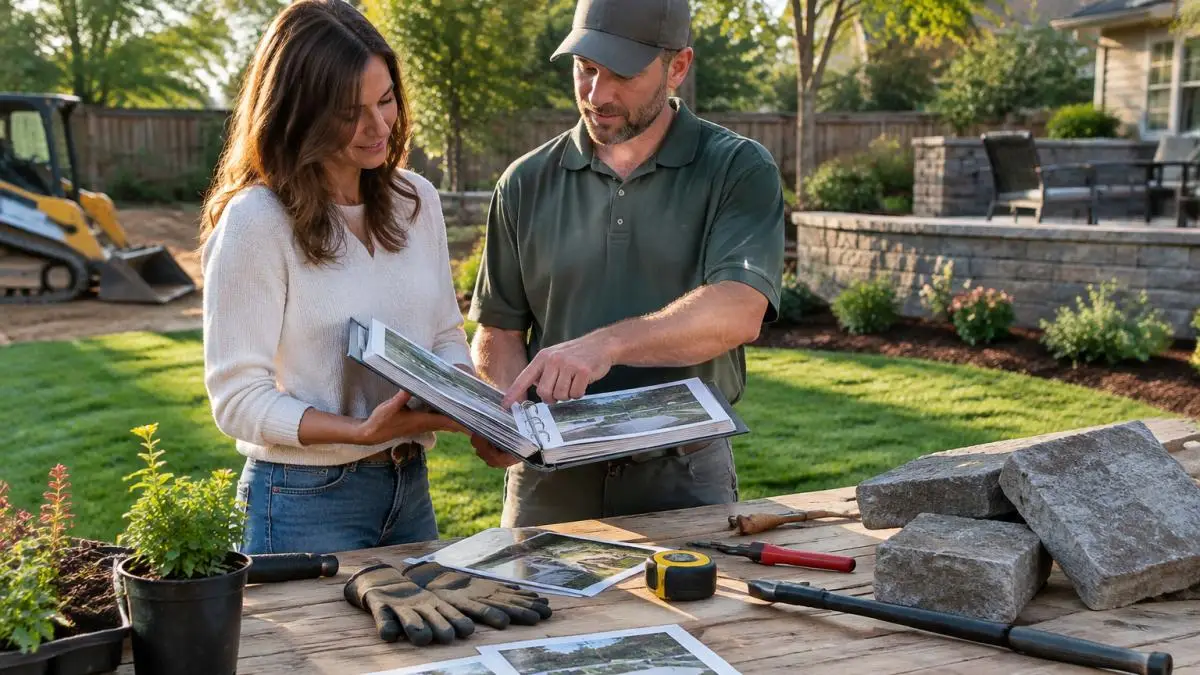
How to check landscaping contractor references comes down to three moves: call recent customers, view completed projects in person, and read reviews with a skeptical eye. Ask each reference how the crew handled problems, whether the final bill matched the estimate, and whether they’d hire the company again.
Reading Reviews and Testimonials Critically
Online reviews are useful, but patterns matter more than star averages. Read the two- and three-star reviews first, since they usually describe real friction points. A company with a few honest complaints and thoughtful replies is often more trustworthy than one with a perfect score and no detail. Ask to see photos of past projects, and browse our gallery of excavation and land clearing projects to see what documented work looks like.
Step 5: Landscaping Contract Requirements and Payment Safeguards
Every landscaping contract requirements list should include the scope of work, materials and quantities, start and completion dates, total price, payment schedule, warranty terms, and a change-order process. Get all of it in writing before work begins. The difference between a smooth project and a dispute usually comes down to how specific those clauses are, not whether they exist.
What a Written Agreement Should Specify
A contract that survives a side-by-side review answers these questions in plain language:
- Scope and quantities: Which beds, zones, or square footages are included, and what is explicitly excluded (for example, hauling away old sod or repairing irrigation lines damaged during excavation).
- Materials and specifications: Plant species and sizes, sod type, mulch depth, hardscape base materials, and soil amendments.
- Schedule: Start date, expected duration, weather contingencies, and how delays are communicated.
Change Orders and Warranty Terms
A change order is a written amendment to the original contract, signed by both parties, covering any added or altered work and its cost. Never accept verbal changes.
For warranties, confirm in writing what is covered, for how long, and who performs the repair. Workmanship warranties and plant guarantees are usually separate: workmanship covers installation defects, while a plant guarantee typically covers replacement of plants that fail to establish within a stated period, often conditional on proper watering and care.
Payment Safeguards and Warning Signs
Pay in stages tied to milestones, keep a final payment until the punch list is complete, and never pay the full contract upfront.
Other red flags include pressure to sign immediately, cash-only payment requests, no written contract, reluctance to provide insurance certificates, and requests to pull permits in your name. For a deeper walkthrough of contract terms, read avoiding contractor disputes on projects.
Get a Free Estimate from Davis & Company
Vetting a contractor takes an afternoon of phone calls and document checks. Skipping it can cost you a season of rework.
See our landscaping services and request a free estimate to start comparing your options with clear answers.
We’ve built our business on showing up when we say we will and putting the scope in writing before the first shovel moves.
Frequently Asked Questions
How do I know if a landscaping contractor is reliable?
Start with verification. Ask for proof of licensing where your state requires it, a certificate of insurance showing general liability and workers’ compensation coverage, and a written contract before work begins. Then check references from projects similar to yours and read recent reviews for patterns, not one-off complaints. A reliable landscaper answers questions directly, provides an itemized written estimate, and puts timelines and payment terms in writing. Reliability shows up in documentation and follow-through, not just a friendly sales pitch.
What questions should I ask a landscaping contractor before hiring?
Ask how long they have worked in your area, whether they carry liability and workers’ compensation insurance, and who will be on site each day. Ask for two or three references from projects like yours, what their warranty covers, and how they handle change orders if the scope shifts. Also ask how they communicate during a project and who to call if something goes wrong. Direct answers to these questions tell you more about a contractor than any brochure.
What should a landscaping contract include?
A solid landscaping contract names the parties, describes the project scope in detail, lists materials and quantities, states the start and completion dates, and sets payment terms with a schedule tied to milestones. It should cover change-order procedures, warranty and plant guarantee terms, cleanup responsibilities, and who handles permits. Ask for the contract in writing before any deposit changes hands, and read the fine print on cancellation and dispute resolution.
Should a landscaping contractor provide proof of insurance?
Yes. Ask for a certificate of insurance showing general liability coverage and workers’ compensation. General liability protects your property if the crew damages a fence, window, or irrigation line. Workers’ compensation covers crew members injured on your property, which protects you from liability. Call the insurer listed on the certificate to confirm the policy is active and the coverage limits match what the contractor claims. Licensing rules for landscape contractors vary by state and locality, so insurance verification matters everywhere.
