
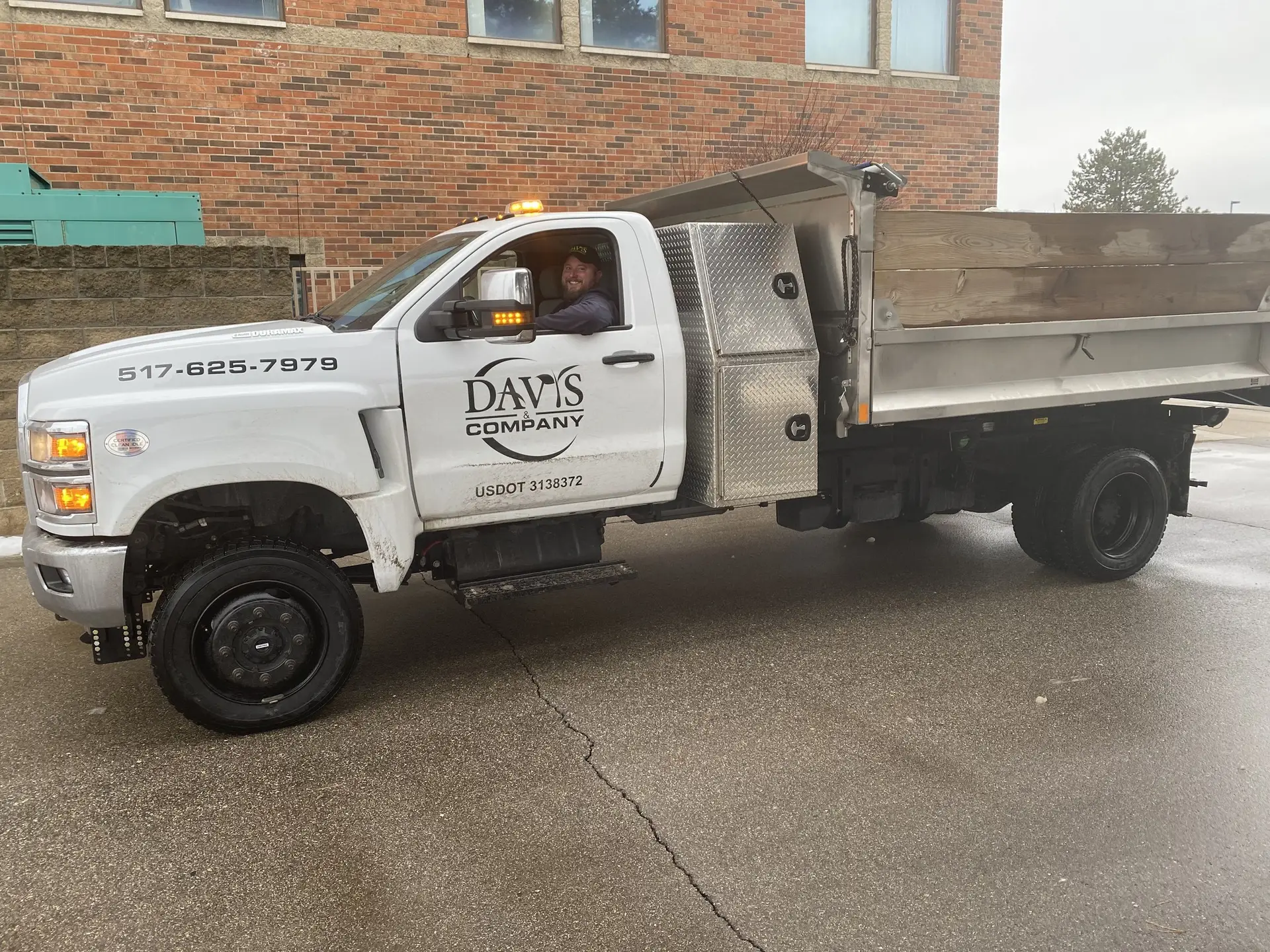
Excavation for drainage means cutting into the ground to change where water goes, using regrading, swales, French drains, catch basins, or a culvert tie-in. On Mid-Michigan’s slow-draining ground, the fix that works is rarely the one owners ask for first.
Every spring we get the same call. A yard holds water for days after a rain, a driveway turns into a creek, or a basement wall starts weeping. Most of the time the owner has already picked the solution: a French drain. Often that’s the one thing we’d tell them not to lead with.
What Is Excavation for Drainage?
Question: What is excavation for drainage? Answer: Drainage excavation is earthwork that redirects water away from buildings and low spots. It includes regrading, swales, French drains, catch basins, and culvert connections, and every design depends on slope, soil conditions, and a legal outlet point.
The outlet is what most drainage advice skips. It also decides whether a system works or just moves your problem 40 feet down the property line.
The Four Fixes We Actually Install
Regrading reshapes the surface so water sheds away from a structure instead of pooling against it. A swale is a shallow, sloped channel that carries surface water across a property on purpose. A French drain is perforated pipe in a gravel trench that collects water below grade. A catch basin is a grated box that captures runoff and pipes it to a culvert or ditch.
Most properties here need two of these working together, not one working alone.
Why Most French Drains Fail on Mid-Michigan Ground
A French drain only works if two things are true: water has to reach the pipe, and the pipe needs somewhere lower to send it. Around Perry and Shiawassee County, the second one usually breaks.
Much of the ground here formed in loam and clay loam till. Capac is one of the most widespread soil series in the area, and the USDA’s description of the Capac series is specific: somewhat poorly drained, moderately slow permeability, and a seasonal high water table half a foot to a foot and a half below the surface at some point from September through May.
Read that depth again. A standard French drain gets trenched 18 to 24 inches down. On a soil like that, for much of the year, the pipe sits inside the water table instead of above it. A drain surrounded by groundwater doesn’t drain. It fills.
We’ve dug up failed French drains where the pipe was intact and the fabric was clean. The install wasn’t the problem. The pipe had no fall to anywhere lower, so it held water instead of moving it.
That’s why surface work comes first here. Fix the grade, cut a swale, get water moving before it stalls. A drain added after grading is a real upgrade. One installed instead of grading is an expensive gravel trench.
Pro Tip: If a contractor quotes a French drain without seeing your property after a hard rain, get a second opinion. Standing water shows the real problem far better than a dry-day walkthrough.
The Test We Run Before We Quote
Before we price a drainage job, we dig a test hole a foot or two deep, fill it with water, and watch how fast it drops, the same basic idea as MSU Extension’s soil infiltration method. We also check whether the hole takes on water by itself, which tells us the water table is already up.
Those two checks change the recommendation. A slow drop means the design has to move water across the surface. A hole that fills on its own means a drain has nowhere to go and grading has to carry the job. It costs 20 minutes and decides whether the system works next April.
Did You Know? The soil under a lawn often isn’t the soil the site started with. When a basement gets dug, that subsoil usually ends up spread across the yard under a thin layer of topsoil. MSU Extension notes that soil layering blocks water movement between layers, which is why a newer home can drain worse than untouched ground beside it.
The Question That Kills Most DIY Drainage Projects
Where does the water go?
Every system needs a legal outlet: a point lower than the collection area that can accept the volume you send it. Around here that means a road ditch, a county drain, an existing field tile, a daylight outlet on your own land, or a dry well.
Two of those come with rules. Under Michigan law on county road rights-of-way, no one may perform work inside a county road right-of-way without a permit from the road commission, and that covers ditch work, culverts, and drainage changes at the road. County drains are separate, administered by the county drain commissioner under Michigan’s Drain Code of 1956. The Shiawassee County drain office publishes its own permit guidelines and reviews stormwater discharge into county drains. Neither approval is hard to get. Both are costly to skip after pipe is in the ground.
Then there’s your neighbor. Michigan follows the reasonable use rule for surface water: you can improve your property and change how water moves across it, but not in a way that unreasonably harms an adjoining owner. Piping runoff onto a neighbor’s land is the version that ends up in a lawyer’s office, and it rarely solves anything.
Matching the Fix to the Problem
| What you’re seeing | Likely cause | Usual fix |
|---|---|---|
| Standing water against the foundation | Ground slopes toward the house | Regrade, extend downspouts |
| Yard soggy for days after rain | Slow soil, no surface outlet | Swale and regrade |
| Driveway washing out at the road | Missing or undersized culvert | Culvert install or replacement |
| One wet low spot mid-yard | Isolated depression | Catch basin piped to daylight |
| Wet basement wall, dry yard | Water at footing level | Footing drain with gravity outlet |
Driveway flooding is its own category. When water crosses a driveway instead of passing under it, the answer is usually culvert installation sized to the drainage area, not another trench beside the drive. On county roads the road commission sets the culvert diameter and length as part of the permit, so that sizing isn’t yours to guess at.
What to Expect on a Drainage Excavation Job
Most residential drainage work runs one to three days once the design is set. Larger farm drainage, or a long pipe run to a new outlet, takes longer. The bigger scheduling factor is ground condition: saturated soil in early spring won’t hold equipment or compact properly, so late spring through fall is the productive window.
Grading and pipe work leave bare soil behind, and bare soil on a slope erodes fast. We usually pair drainage jobs with hydro-seeding so the ground stabilizes before the next heavy rain. Our complete guide to excavation covers trench, foundation, drainage, and pond work together.
Pro Tip: Photograph your yard during the worst 24 hours of standing water you get this year. Those photos beat any description, and they let your excavation contractor design around real water behavior instead of guesswork.
The Bottom Line on Drainage Excavation
Drainage problems get solved by matching the fix to the ground conditions and finding a legal place for the water to go. Around Perry and the surrounding townships, that starts with grade and surface flow, not a trench full of gravel. Get those right and a drain becomes an upgrade instead of a rescue attempt.
If your property holds water, floods a driveway, or pushes moisture toward a foundation, call Davis & Company at (517) 625-7979 or request a free site assessment. We’ll walk the property, run the infiltration check, confirm where your outlet can legally go, and give you a straight answer on what the job requires.
Frequently Asked Questions
What is excavation for drainage? Drainage excavation is earthwork that redirects water away from buildings and low areas. It includes regrading, swales, French drains, catch basins, and culvert connections, all designed around slope, soil conditions, and a legal outlet point.
Do French drains work in Michigan’s slow-draining soils? Only with a lower outlet. Many local soils carry a seasonal high water table within six to eighteen inches of the surface from fall through spring, which can put a standard 18 to 24 inch drain inside the water table. Regrading and a swale usually need to come first.
Do I need a permit for drainage work in Michigan? It depends on the outlet. Any work inside a county road right-of-way, including ditch and culvert work, requires a road commission permit. Discharge into a county drain is reviewed by the county drain commissioner, and work near wetlands or regulated waters may require an EGLE permit.
How long does a drainage excavation project take? Most residential drainage jobs take one to three days once the design is set. Larger farm drainage or long pipe runs to a new outlet take longer, and saturated spring ground can delay a project until conditions improve.