
Last Updated: October 31, 2026
Quick Summary
To find reliable snow removal services, verify insurance and licensing first, then check reviews and references for patterns across recent winters. Ask every provider the same questions about storm dispatch, equipment, and contract terms, and get the answers in writing. Davis & Company, family owned and operated since 2015, offers snow removal services across Mid-Michigan.
- Request a current certificate of insurance covering the full winter season.
- Read the last two winters of reviews and look for repeated failure words like late or damage.
- Ask for references from properties of similar size and surface to yours.
- Get the snow depth trigger, response window, and pricing structure in writing before signing.
- Read the liability clause to confirm who pays if the crew damages your property.
Table of Contents
- Why Reliability Matters More Than the Lowest Quote
- Step 1: Check Insurance, Licensing and Liability Coverage
- Step 2: Verify Reviews and References Before You Sign
- Step 3: Ask the Right Questions Before Hiring
- Step 4: Review the Snow Removal Service Contract Terms
- Booking Your Winter Coverage With Davis & Company
- Frequently Asked Questions
Snow removal is one of those services you only think about when the first storm hits and the driveway is buried. By then, the wrong choice is already costly. Picking a provider based only on the lowest quote can leave you with missed plowing, unpaid damage claims, and a lot of frustration. Knowing how to find reliable snow removal services before winter starts is the best way to protect your property, your schedule, and your budget.
Why Reliability Matters More Than the Lowest Quote
The cheapest bid is rarely the cheapest winter. A provider who shows up late, skips your lot during a heavy storm, or leaves ruts and broken landscape lighting can cost you far more than the price difference.
Reliability means three things:
- Consistent arrival times during overnight storms
- Clear communication when conditions change
- Accountability when something goes wrong on your property
At Davis & Company, we have been family owned and operated since 2015, and we know that dependable winter service is built on showing up and standing behind the work.
Step 1: Check Insurance, Licensing and Liability Coverage
Before you talk price, confirm that the provider is properly protected. Ask for proof, not just a verbal promise.
Watch for these items:
- General liability insurance covers damage a crew causes to your property or to others
- Workers’ compensation coverage protects the crew if someone gets hurt on your site
- Business licensing shows the company is registered to operate in your area
Request a current COI and check that the dates cover the full winter season. If a provider hesitates to share it, treat that as a warning sign.
Step 2: Verify Reviews and References Before You Sign
Online reviews are a starting point, not proof. Most directory listings show a star average and a handful of comments, which tells you almost nothing about how a provider behaves during a 10-inch overnight storm. Treat reviews as a screening tool and references as the real test.
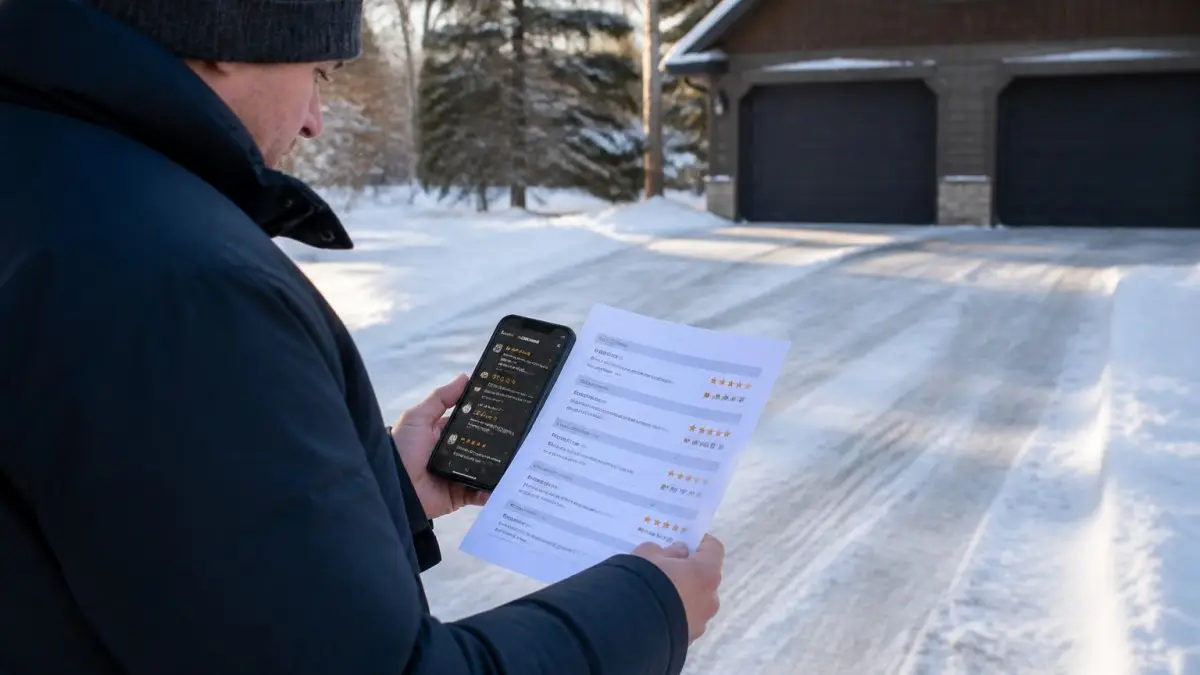
Read reviews for patterns, not highlights
- Look at the volume and spread of reviews, not just the top rating. A provider with 40 reviews across three winters is more informative than one with six reviews from a single season.
- Sort by newest first and read the last two winters. Snow removal is seasonal, so a strong 2021 review says little about current crews.
- Search the review text for the words that matter: late, no-show, damage, invoice, callback. Those are the failure modes you are trying to avoid.
Ask for references from properties like yours
A residential driveway and a commercial parking lot are different jobs with different equipment and priorities. When you request references, be specific about what you want:
- Two or three properties of similar size and surface to yours
- At least one that has been served for two or more seasons
- Ideally one that experienced a major storm event with that provider
Run a structured reference call
A five-minute call with a prepared list of questions beats a vague “were they good?” Here is a checklist you can use:
- Did the crew arrive within the window they promised during the last major snowfall?
- Was the property cleared completely, including walkways, steps, and the pile placement, or did you have to call them back?
- How did the company communicate delays or schedule changes?
- Were there any surprise charges on the invoice?
- If something was damaged, how quickly was it resolved?
- Would you hire them again next season, and why or why not?
Write down the answers side by side for each candidate. Patterns emerge fast, two references mentioning “we had to call twice” is a stronger signal than any star rating.
Cross-check public records
Reviews and references are self-reported. Before you sign, verify the basics independently:
- Confirm the business registration through your state’s secretary of state business search.
- Check for complaints with your state attorney general’s consumer protection office and the Better Business Bureau.
- Ask whether the company carries general liability and workers’ compensation coverage, and request a current certificate of insurance (COI) naming the coverage limits and policy dates. The COI should cover the full winter season.
A provider who hesitates to share a COI or whose registration does not match the name on the contract is a warning sign, no matter how good the reviews look.
Step 3: Ask the Right Questions Before Hiring
A short interview separates providers who run a real operation from those who plow on the side. The goal is not to stump anyone, it is to get specific, verifiable answers you can compare across candidates. Ask the same questions of every provider and write the answers down.
Dispatch and storm communication
- What snow depth triggers a visit? Trigger depths vary by provider and property type, so get the number in writing. Get the number in writing.
- How do you decide when to start? Look for a stated policy, for example, crews dispatched when accumulation reaches the trigger or when a winter storm warning is issued.
- What is your typical response time after snowfall ends? Ask for a range and ask what happens during a back-to-back storm.
Equipment and property fit
- What equipment will you use on my property? A truck with a straight blade, a skid-steer, a sidewalk machine, and a salt spreader are different tools for different surfaces.
- How do you protect delicate surfaces such as stamped concrete, pavers, decorative gravel, or landscaping beds?
- Where will snow be piled? Pile placement matters, a pile pushed against a foundation, fence, or drain can cause water problems at melt.
Contract and pricing mechanics
- Is pricing seasonal, per-visit, or per-push? Each structure shifts risk differently. Seasonal pricing is predictable, while per-visit pricing depends on how much snow falls, so ask each provider how its structure works.
- What triggers an extra charge? Ask about overage thresholds, ice-event surcharges, hauling snow off-site, and holiday or after-hours rates.
- What is the cancellation and renewal policy? Note the notice period and whether the contract auto-renews.
Backup and continuity
- Do you have crews that cover my property if the main crew is unavailable? Equipment breaks and crews get sick during the busiest weeks of the year.
- How many properties are on your route, and where does mine fall? A provider juggling too many accounts will triage during a major storm.
- What happens if a storm exceeds forecast? Ask how they prioritize and whether they bring in additional equipment.
Vague answers like “we’ll get to it when we can” or “don’t worry about it” are the clearest signal that you will be on a long wait list during the storm that matters most. Push for a number, a name, or a written policy.
Get it in writing
Verbal answers are easy to forget and hard to enforce. Ask each provider to confirm the trigger depth, response window, after-hours contact, and pricing structure in the written estimate or contract. If a provider will not put those details in writing, treat that as a warning sign regardless of how confident the sales pitch sounds.
Step 4: Review the Snow Removal Service Contract Terms
The snow removal service contract matters as much as the verbal promises. Read it carefully before you sign.
Look for these details:
- Service scope: Does it cover plowing only, or also salting, walkways, and steps?
- Trigger points: At what snow depth does the crew come out?
- Pricing structure: Is it a seasonal flat rate or a per-push charge? Ask what changes the price.
Pricing depends on property size, service frequency, and the terms you choose. Contact us for current pricing or a free estimate.
Before you sign, check these contract details, since the terms matter as much as the verbal promises.
| Contract detail | What to look for | Why it matters |
|---|---|---|
| Service scope | Plowing only, or also salting, walkways and steps | Defines what you are paying for |
| Trigger points | Snow depth that brings the crew out | Sets when service starts |
| Pricing structure | Seasonal flat rate or per-push charge | Shows what changes the price |
| Cancellation terms | Notice required to end the contract | Limits your exit cost |
| Liability clause | Who pays if the crew damages property | Determines damage responsibility |
Booking Your Winter Coverage With Davis & Company
Winter is coming, and the best time to lock in reliable service is before the first flake falls. Davis & Company provides snow removal services for homes, farms, and commercial properties across Mid-Michigan, with snow plowing for driveways, farm roads, and commercial lots.
Ready to compare options? Contact us for a free estimate and we will walk you through coverage, timing, and contract terms. You can also review our frequently asked questions to see how we handle storms and service scheduling.
Frequently Asked Questions
How can I verify a snow removal company’s references and credentials?
Ask the company for at least three recent references from properties similar to yours, then call those customers and ask about response time during a storm, damage to property and how billing was handled. Ask for a current certificate of insurance and confirm the policy is active by contacting the insurer or the issuing agent. Check that any required state or local business registration is current. A provider who hesitates to share references or certificates is a warning sign.
Should I choose per-visit snow removal or a seasonal contract?
Per-visit billing suits properties with light, infrequent snowfall, while a seasonal contract suits properties that need consistent coverage through a long winter. Compare what each option includes, such as storm priority, salting, and after-hours response, rather than only the headline price. Ask how the contract handles snowfall below the agreed trigger depth, and whether the rate changes if the season runs long.
What does snow removal insurance cover?
Commercial general liability insurance generally covers injuries and property damage caused by the contractor’s work, such as a plow damaging a mailbox or a slip-and-fall claim tied to poorly cleared surfaces. Workers’ compensation covers the crew if they are hurt on the job. Ask for the certificate of insurance to list your property as certificate holder, and confirm the coverage limits meet your needs. Policies vary, so read the actual terms before relying on them.
What questions should I ask before hiring a snow removal company?
Ask how quickly they respond after snowfall reaches the agreed depth, who you call after hours, and whether they salt or only plow. Ask who is responsible if their equipment damages landscaping, lighting or pavement, and how they document the property before the season starts. Ask whether the crew is employees or subcontractors, and how they communicate during major storms. Clear answers to these questions usually predict how the season will go.
