
Snow plowing in Perry, MI is a rural problem with a rural answer. The Shiawassee County Road Commission maintains 1,097 miles of county road and 282 lane-miles of state highway, and its crews clear the primary routes — I-69, M-52, M-21 — before they turn down a gravel section road or a subdivision street. That is the right call for a county this size. It also means the end of your driveway is nobody’s job but yours, and the same pass that opens the road leaves a packed ridge across your approach. Davis & Company has plowed here since 2015: long farm drives out past Ellsworth Road, subdivision loops off Main Street, commercial frontage at I-69 Exit 105. We live here. Our trucks are moving before Perry Public Schools makes the call. Call (517) 625-7979 for a free quote.
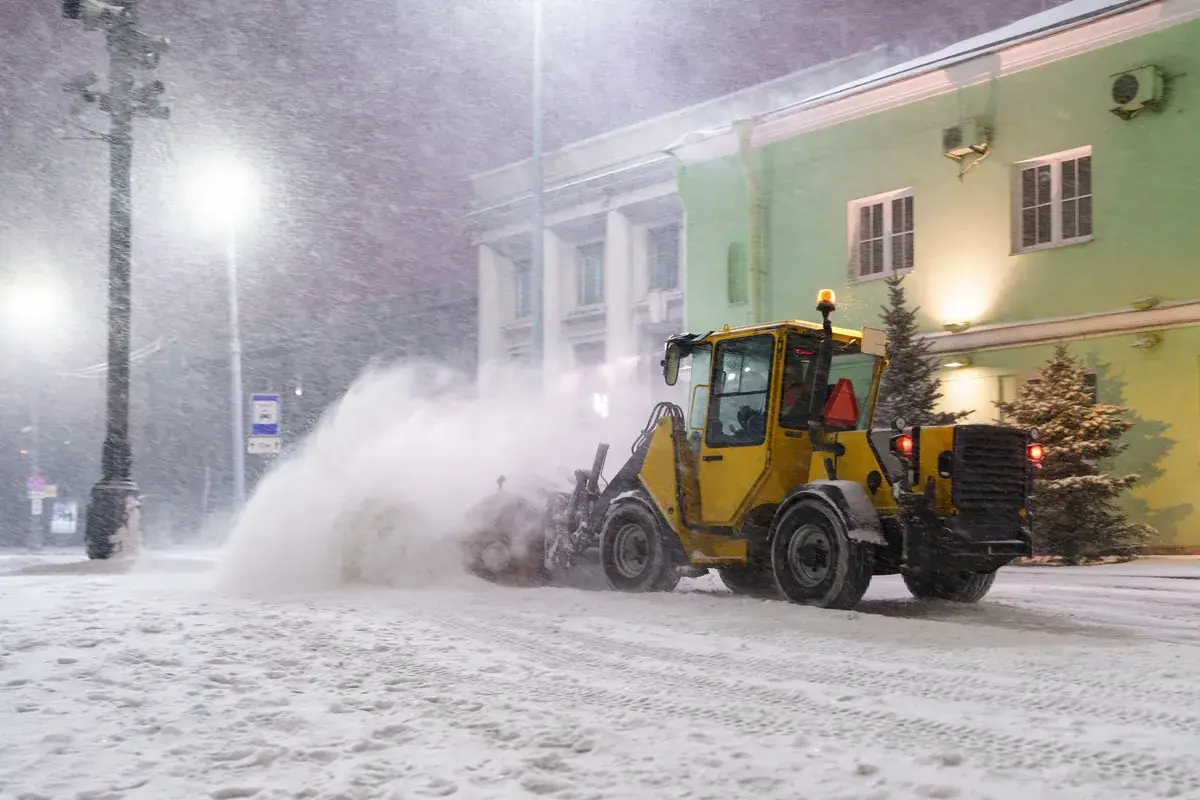
Snow plowing is the mechanical work of pushing accumulated snow off a driveway, lot or access road and stacking it where it won’t cause a second problem. It is not the same thing as snow removal, which means physically hauling snow off the property. The job starts in the fall, not during the storm: we walk the site, note the culvert ends, catch basins, septic lids and curb noses that vanish under eight inches, and stake the edges of gravel drives and landscape islands so a blade never finds them the hard way. When accumulation reaches your trigger depth, the route runs, and which machine arrives depends on the property. A straight blade on a three-quarter-ton truck is fastest on long rural drives and open runs where snow can roll off the end of the pass. A V-plow earns its keep on tight subdivision drives and lots with islands — the V position splits hard drifts and the bank-packed ridge the county plow leaves, scoop position holds snow in front of the blade so each pass carries more volume, and straight mode handles the rest. On large lots we run a skid steer or compact loader with a box pusher, which moves snow in bulk instead of throwing windrows sideways that have to be re-handled. On gravel, the shoes come down so the blade floats above the stone instead of peeling it into the lawn. What you get is squared edges, a clean approach at the road, and piles set where they won’t blind you pulling out or melt back across the pavement at four in the afternoon.
Every new property gets a fall site walk before the ground freezes. We locate and stake the things a blade should never find: culvert ends, catch basins, septic lids, well heads, curb noses, landscape island corners and the soft shoulder where a gravel drive meets turf. We mark the stacking areas at the same time, keeping piles off the sight lines at the road and off the uphill side of a lot, where afternoon meltwater runs back across the pavement and refreezes after dark. You get the marked-up plan, so there is no argument in February about where the snow was supposed to go.
Your trigger depth is the accumulation that sends a truck. Two inches is the common setting for residential drives and most commercial lots; properties with heavy foot traffic sometimes drop to one inch, and long farm drives occasionally sit at three. We track each system against the National Weather Service forecast for Shiawassee County and stage equipment before the front arrives instead of after. You don’t have to call, and you don’t have to be awake. On a long-duration event we make more than one pass so accumulation never gets deep enough to pack down into hardpack you can’t scrape off.
Commercial accounts run first, because a lot has to be open before staff and customers arrive and because an unopened lot is a liability exposure, not just an inconvenience. Residential drives follow, grouped geographically so we aren’t burning windshield time running back and forth between Perry and Morrice. Each property gets the machine it was assigned in the fall — straight blade on the long open runs, V-plow where drifts pack hard or the drive is tight, box pusher on the big lots. We plow to the marked stacking area, not to whatever open space is closest to the blade.
The difference between a plowed driveway and a finished one is the last five minutes. We back-drag the apron at the garage door so you aren’t pushing a berm into it, square the edges so the usable width of the drive doesn’t shrink a foot every storm, and cut a clean approach at the road wide enough to pull out with sight lines in both directions. Snow from the approach goes back onto your property, never into the road — Michigan law is specific about that, and a contractor who ignores it is quietly handing you the problem.
Every visit is time-stamped and logged: property, arrival, conditions, what was plowed and what was applied. For commercial clients that log is the documentation your insurer asks for the first time somebody files a slip-and-fall claim. And when the county plow comes back through after the storm and walls off your approach a second time, that is a return trip, not an argument — it is the single most common winter complaint out here, and it is built into how we route. What you end up with is a drive you can leave at 5:30 in the morning without thinking about it.
Snow work is different from excavation: the route has to stay tight or nobody gets plowed on time. Most of our plowing runs inside Perry Township, the City of Perry and the Village of Morrice, plus the surrounding sections of southwestern Shiawassee County — the gravel roads off M-52, the subdivision streets near Main Street and Jubilee Park, and the commercial frontage around I-69 Exit 105. We take commercial accounts farther out along the I-69 corridor toward Laingsburg, Bath, Durand and Bancroft, and into the Lansing and Okemos area, where a single larger property justifies the drive. The rest of what we do across Mid-Michigan — excavation, driveways, land clearing and site prep — is on our Mid-Michigan excavation and property services page.
The conditions here shape the work. Lansing averages roughly 50 inches of snow a year and Flint roughly 52, based on 1991–2020 climate normals, and Perry sits squarely between the two. The census counts Perry Township as entirely rural, which in plowing terms means long driveways, gravel surfaces, and open farm frontage where a west wind rebuilds a drift twenty minutes after you clear it. A blade set for asphalt will strip a gravel drive into the yard by March, and drifting on open frontage needs a V-plow and a second pass, not a bigger truck. That is local knowledge you only get from plowing the same roads for a decade.
Davis & Company is family-owned and has operated out of Perry since 2015 under owner Todd Davis Jr., and the company holds an A+ rating with the Better Business Bureau. Snow is not a sideline we picked up to fill a gap in the calendar — the original business was lawn care and snow plowing, and everything else grew out of it. You deal directly with the people who run the trucks, not a call center, and you get straightforward pricing with nothing padded on after the fact. You can learn more about our team and how we got started on our About page.
The equipment advantage is real, and it comes from the excavation side of the business. Most plow contractors own trucks. We also own skid steers, compact loaders and dump trucks that work year-round, which means when a storm buries a lot past what a pickup can handle we aren’t calling a rental yard — we’re bringing a machine that was already on the schedule. It also means we can stack snow high and tight with a loader instead of surrendering ten parking spaces to a pile, and haul it off the site outright when the stacking areas fill.
We also plow to the rules, which matters more than it sounds like it does. Michigan’s vehicle code prohibits removing or depositing snow, ice or slush onto a roadway or its shoulder in a way that obstructs safety vision, and prohibits depositing it on the roadway at all (MCL 257.677a). That rule exists because a pile at the end of a driveway is the thing a driver hits before they ever see the car pulling out of it. Snow from your approach goes back on your property. Our schedule is also built around the county road commission’s clearing priorities rather than in competition with them, so we aren’t opening an approach a county truck is about to bury again twenty minutes later.

 Office Boggetta
Trustindex verifies that the original source of the review is Google.
Great local business! Davis and Company responded quickly and put salt down right away so our staff could safely travel our driveway. Reliable, prompt, and much appreciated. Anthony BoggettaTodd and his team were a giant lifesaver today as our entire crew Ice skated across the parking lot thanks for them nobody was hurt and we will be treading safe safely🙏🙏🙏
 Hayley JohnsonGreat place to get gravel! Was able to meet us last minute on the weekend to get us what we needed.
 Candace WhitscellGreat customer service, services well done.
 Virginia GibneyPrompt well-priced service. They tackled a tough job and got it done right. Hard working employees, I would recommend them to anyone.
 jeanette gomosWE HAD SOME TREES REMOVED BY TREE SPADE AND THAT LEFTMY YARD A MESS DAVIS ANSWERED MY CALL AND WERE THER AS PROMISED THE VERY NEXT DAY ; TO SOOMTH WITH FRESH BLACK SOIL AND GRASS SEED . WE ARE VERY HAPPY WITH THE OUTCOME
 Robert AldridgeDid very good job on my driveway.
 Katherine ChapmanAttentive to details and flexible work ethic.
Plowing pushes snow to a stacking area somewhere on your property. Snow removal is the broader service: plowing plus salting and de-icing, sidewalks and entryways, and physically hauling snow off-site with a loader and dump trucks when the piles have nowhere left to go. Most residential driveways only ever need plowing. A commercial lot that has lost a dozen parking spaces to snow piles by mid-January needs removal.
Two inches is the standard trigger depth for residential drives and most commercial lots, and it is the number most contracts in Michigan are written around. You can set it lower — properties with steady foot traffic often run a one-inch trigger so nothing gets tracked in and packed down — or higher on a long farm drive where a dusting is not worth a visit. We set your trigger in writing before the season starts so there is never a question about whether a storm counted.
It will if it is plowed like asphalt. A blade dropped flat on frozen gravel peels stone into the lawn, and by spring you are short a load of 21AA and have a new crown of rock along both edges. We run shoes or skid shoes set so the blade floats above the surface, take the first storm of the season carefully before the base has frozen solid, and angle the pass so material stays on the drive. If a gravel drive has already lost material or holds water, our driveway installation and improvement crew can regrade it once the frost is out — a properly crowned drive plows better every winter after that.
It depends on the surface, the length and width of the drive or lot, how far snow has to travel to a stacking area, and whether you want per-push or seasonal billing. Per-push means you are invoiced each time we run, which suits a light winter and a short drive. Seasonal is a fixed price spread over the winter regardless of how many storms come, which suits commercial properties and anyone who would rather budget one number than gamble on the weather. We quote both, in writing, after looking at the property. Estimates are free, and you can ask us about our financing.
Both. Commercial accounts run first because those properties have to be open before the workday starts, but residential drives are a core part of what we do and always have been — the company started as a lawn care and snow plowing business in 2015. Farm and acreage drives are a specialty here: long approaches, gravel surfaces and open drifting frontage are ordinary conditions, not an exception we charge extra to deal with.
On a typical two-to-four-inch event, most of the route is cleared within a few hours of the snow stopping, commercial properties first. On a long or heavy storm we run multiple passes during the event rather than waiting it out, because snow that sits gets driven on and packs into a layer that has to be scraped rather than pushed.
Snow plowing is one piece of keeping a property usable all year. Most of our winter clients are already on the calendar for lawn care in the spring and fall cleanup in October, and a crew that has plowed your drive all winter knows where the drainage problem is that caused the ice. Routes fill before Thanksgiving. Call (517) 625-7979, or request a free quote through our contact page. Free estimates on every job, and ask us about our financing.