
Full-service snow removal in Perry, MI starts where plowing stops. A plow moves snow to the edge of your lot. By the third storm of a Michigan January, that edge is a six-foot pile sitting on a dozen parking spaces, shedding meltwater across the drive lane every afternoon and freezing it into black ice every night. Davis & Company handles the whole winter problem for commercial properties and larger residential sites across Shiawassee County — plowing, salting and de-icing, sidewalks and entryways, and hauling snow off-site with a loader and dump trucks when the stacking areas are full. We have run winter operations out of Perry since 2015, and the excavation equipment that clears your lot in February is the same fleet that grades your driveway in June. Call (517) 625-7979 for a free site assessment.
Snow removal is the full winter-management package: everything snow plowing does, plus ice control, pedestrian surfaces, and the physical relocation of snow off the property. A managed event usually begins before the snow does, with an anti-icing application laid down ahead of the storm so snow never bonds to the pavement and the first pass scrapes to bare surface instead of polishing a layer of hardpack. During the event, loaders and skid steers running box pushers move bulk snow off drive lanes and parking rows while a walk crew works blowers, shovels and walk-behind spreaders across sidewalks, ramps, entry mats and the striped access aisles that get skipped and later generate claims. De-icing follows the plow rather than preceding it — material spread onto snow that is about to be pushed is material you paid for and threw away. Product selection is a temperature decision: rock salt is effective down to roughly 15°F and does very little below that, while calcium chloride works to about -20°F, magnesium chloride to about -13°F, and calcium magnesium acetate to about -15°F with far less damage to concrete and landscape beds. When the stacking areas stop holding volume, a loader charges tandem dump trucks and the snow leaves the site entirely. The point of all of it is simple: your lot has the same number of usable parking spaces in February that it had in November, and nobody falls down on the way in.
Before the season starts we walk the property and map it: drive lanes and traffic flow, fire lanes, dumpster approaches, loading docks, accessible parking and the ramps serving it, storm drains and catch basins, and every square foot of sidewalk the walk crew will own. We mark the stacking areas with the drainage in mind, because a pile placed uphill of an entrance turns into a sheet of ice at that entrance every single thaw. Then we put the scope in writing: trigger depth, what gets plowed, what gets shoveled, what gets salted, what is billed per application, and who is responsible for what. Most winter disputes are scope disputes that were never written down.
When conditions call for it, we pre-treat drive lanes, entrances and walkways ahead of the front. Anti-icing puts a layer between the pavement and the falling snow so the two never bond, which means the plow pass actually reaches the surface and you need meaningfully less de-icer afterward. It is also the difference between a lot that is clear at 7 a.m. and a lot that has a polished ice layer under three inches of powder. Pre-treatment is not appropriate for every storm — rain ahead of the changeover washes it off — so we make that call per event rather than applying it on autopilot.
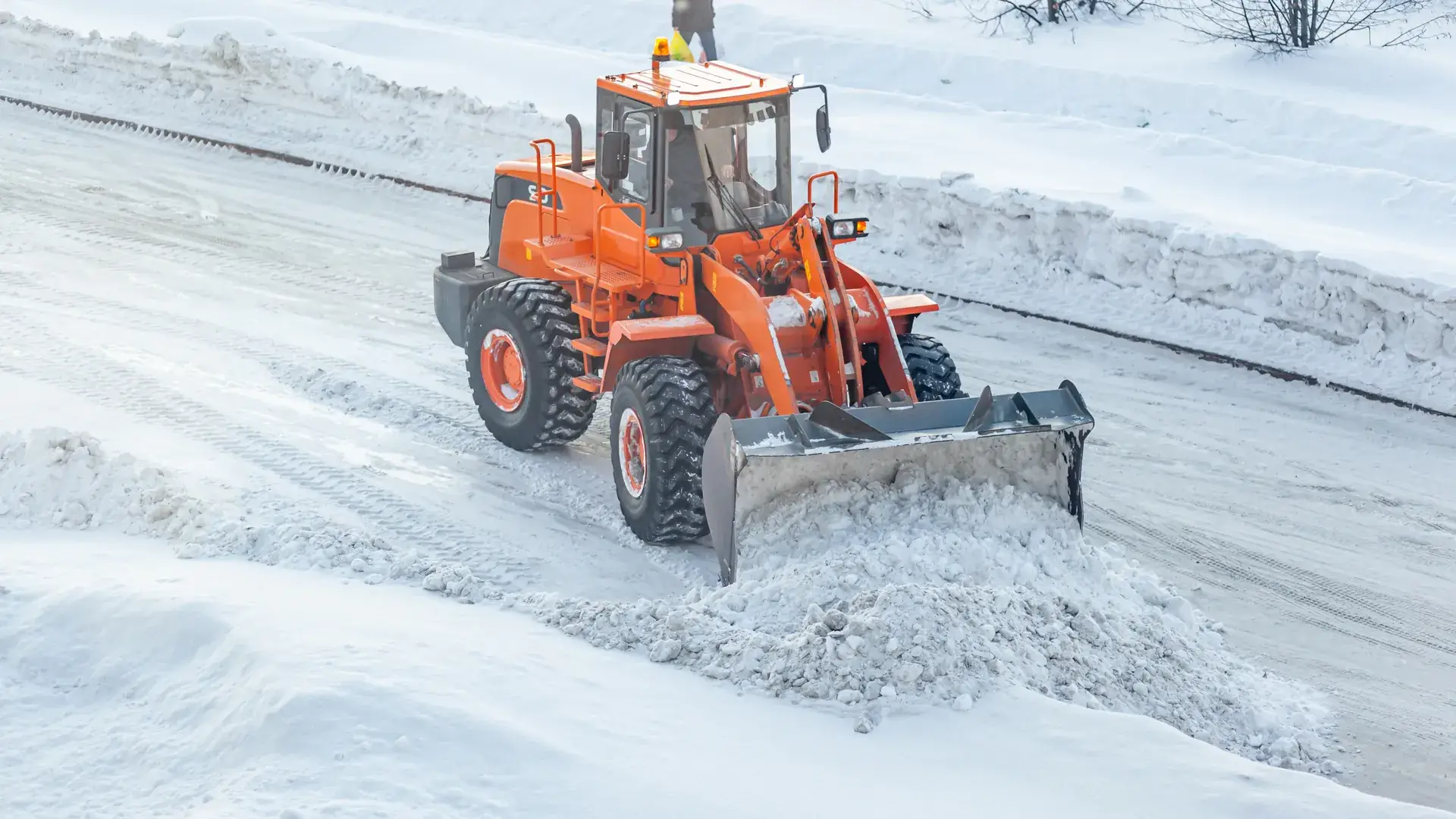
On a long event we work during the storm instead of waiting it out, because snow that gets driven on packs into a layer that has to be scraped rather than pushed. Loaders and skid steers with box pushers carry bulk snow to the marked stacking areas in full-width passes; trucks with blades clean the perimeter, islands and the corners a pusher can’t reach. The walk crew runs at the same time, not afterward, so entrances and accessible routes are open when the first person arrives. Snow from the approach goes back onto the property, never into the road — Michigan’s vehicle code is explicit on that point.
De-icer goes down after the surface is cleared, at a rate matched to the pavement temperature and the forecast, from a calibrated spreader. That calibration matters more than most property managers realize: over-application is the most common and most expensive mistake in the industry, and it does not make the lot safer — it puts chloride into the groundwater, pits your concrete, kills the turf and beds along the lot edge, and costs you money for material that ends up in the storm drain. When temperatures drop below the working range of rock salt we switch product rather than doubling the rate, which is the response that actually works below 15°F.
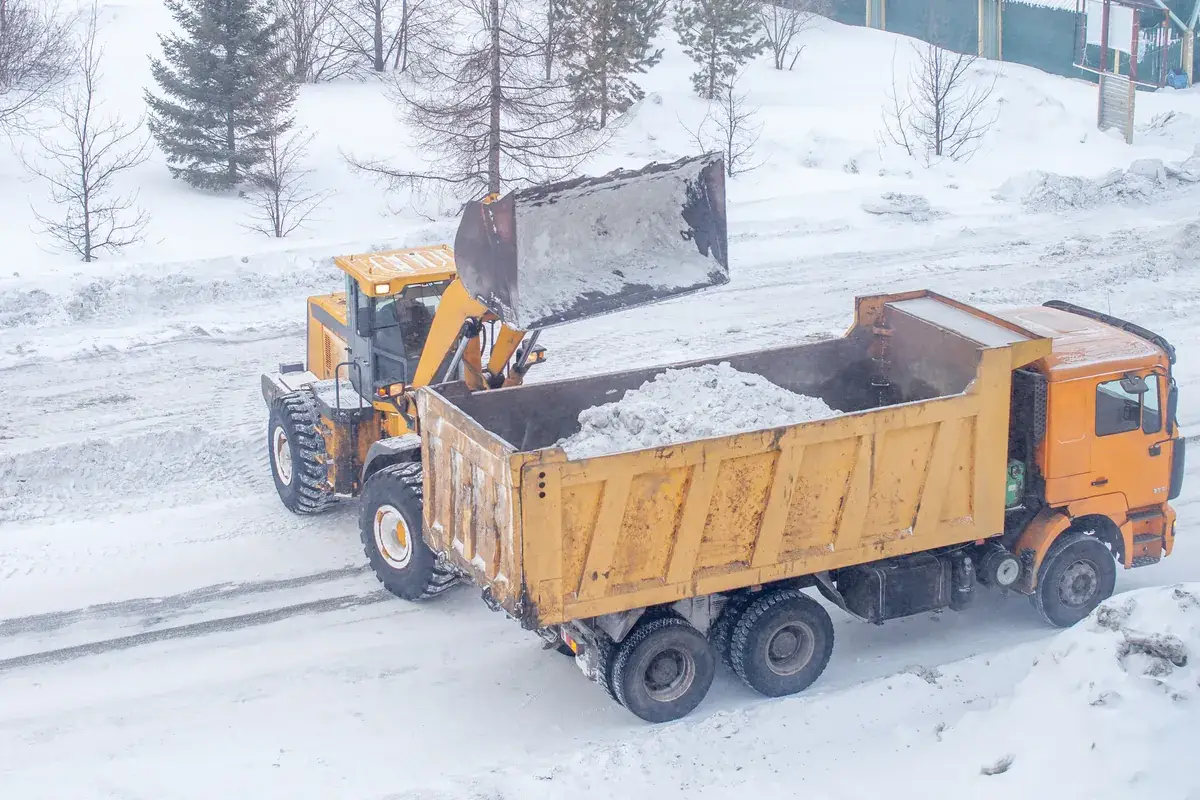
We track your stacking areas through the season and tell you before they become a problem, not after. When piles start eating parking, blocking sight lines at an exit, or draining meltwater back across a drive lane, a loader charges dump trucks and the snow goes off-site. This is the service most properties do not budget for and then need by the first week of February. Every visit is logged with a timestamp, the conditions on arrival, the work performed and the material applied — documentation you will want the first time somebody files a slip-and-fall claim against your property.
Our yard is at 489 W Beard Road in Perry, which puts us minutes from the commercial frontage at I-69 Exit 105 and the M-52 corridor running north toward Owosso. Perry Township sits in southwestern Shiawassee County, centered between Lansing and Flint on I-69, and wraps both the City of Perry and the Village of Morrice. Snow removal accounts run through Perry, Morrice and the surrounding townships, and out along the I-69 corridor toward Laingsburg, Bath, Durand and Bancroft and into the Lansing and Okemos area, where a larger commercial property justifies the equipment move. The rest of our work across Mid-Michigan — excavation, driveways, site prep and land clearing — is on our Mid-Michigan excavation and property services page.
Conditions here justify the full service rather than plowing alone. Lansing averages roughly 50 inches of snow a year and Flint roughly 52, based on 1991–2020 climate normals, and Perry sits between the two with a long freeze-thaw shoulder on either end of the season — the stretch that produces refreeze and black ice rather than fresh accumulation. Because the county road commission clears primary routes like I-69 and M-52 before local and gravel roads, commercial properties out here often open before the road serving them is fully clear, which puts more of the ice-control burden on the owner than it would in a city. Much of the surrounding land is open farm ground, so a west wind rebuilds drifts across an exposed lot long after the snow has stopped.
Davis & Company is family-owned, has operated out of Perry since 2015 under owner Todd Davis Jr., and holds an A+ rating with the Better Business Bureau. The business began as lawn care and snow, so winter is not the slow season we tolerate — it is half of what the company was built to do. You deal directly with the people running the equipment rather than a national dispatch desk, and pricing is straightforward with nothing added after the fact. You can learn more about our team and how we work on our About page.
The real differentiator for commercial work is that we already own heavy equipment. Snow removal — as opposed to plowing — requires loaders, skid steers and dump trucks, and most plow contractors do not have them, which is why haul-off either does not get offered or gets quoted at rental rates after your lot is already full. Ours works year round on excavation and site work, so when your stacking areas fill in February we move snow with a machine that was already on the payroll. That same equipment is what lets us stack tight and vertical instead of spreading piles across parking spaces you are paying rent on.
We also apply material like it costs something, because it does — to you, to your pavement and to the watershed. Michigan EGLE’s winter maintenance guidance points to the same practices we run on: calibrate the spreader, adjust rate to site conditions rather than habit, and account for the corrosion and vegetation damage chloride causes. The temperature thresholds are not marketing either — university extension research on de-icing materials puts rock salt’s practical working limit around 15°F, with calcium chloride effective to roughly -20°F and calcium magnesium acetate to about -15°F while doing little damage to plantings. Knowing which bag to open in a cold snap is the difference between a clear lot and an expensive one.

 Office Boggetta
Trustindex verifies that the original source of the review is Google.
Great local business! Davis and Company responded quickly and put salt down right away so our staff could safely travel our driveway. Reliable, prompt, and much appreciated. Anthony BoggettaTodd and his team were a giant lifesaver today as our entire crew Ice skated across the parking lot thanks for them nobody was hurt and we will be treading safe safely🙏🙏🙏
 Hayley JohnsonGreat place to get gravel! Was able to meet us last minute on the weekend to get us what we needed.
 Candace WhitscellGreat customer service, services well done.
 Virginia GibneyPrompt well-priced service. They tackled a tough job and got it done right. Hard working employees, I would recommend them to anyone.
 jeanette gomosWE HAD SOME TREES REMOVED BY TREE SPADE AND THAT LEFTMY YARD A MESS DAVIS ANSWERED MY CALL AND WERE THER AS PROMISED THE VERY NEXT DAY ; TO SOOMTH WITH FRESH BLACK SOIL AND GRASS SEED . WE ARE VERY HAPPY WITH THE OUTCOME
 Robert AldridgeDid very good job on my driveway.
 Katherine ChapmanAttentive to details and flexible work ethic.
Snow plowing pushes snow to a stacking area on your property and stops there. Snow removal is the full scope: plowing, pre-treatment, salting and de-icing, sidewalks and entryways, and physically hauling snow off the site when the piles have nowhere left to go. A residential driveway almost never needs more than plowing. A commercial lot with pedestrian traffic, accessible parking and a finite number of spaces usually needs all of it.
Both, and the right one depends on how you would rather carry the risk. Per-push bills you each time we service the property, with de-icing and sidewalk work typically billed per application — you pay less in a light winter and more in a heavy one. A seasonal contract is a fixed price for the whole winter, usually spread across monthly installments, so your cost is a budget line instead of a variable. Property managers answering to a board or an owner tend to prefer seasonal for exactly that reason. We quote both against your actual site.
It is driven by measurable things: square footage of pavement, linear feet of sidewalk, how far snow has to travel to a stacking area, your trigger depth, how much ice control the site needs, and whether haul-off is in scope. Two lots of the same size can price very differently if one has three acres of open stacking room and the other has none. We measure the property, put the scope in writing and quote it — estimates are free, and financing is available through our billing system if you would rather spread a seasonal contract out. Ask us about it.
Premises liability in Michigan turns on facts specific to your property and your lease, so this is a question for your attorney and your insurer, not for a contractor. What we can tell you is what defends a claim in practice: a written scope, a documented trigger, and a time-stamped service log showing when the property was serviced, what the conditions were and what material was applied. We log every visit for exactly this reason and provide the records on request. A contractor who cannot produce that log leaves you arguing about a snowstorm from memory.
Because every de-icer has a temperature below which it will not do useful work. Ordinary rock salt is practically effective to around 15°F and does very little under it — spreading more at 5°F does not help, it just puts chloride on the ground. Below that range we switch products: calcium chloride works down to roughly -20°F and generates heat as it dissolves, magnesium chloride to about -13°F, and calcium magnesium acetate to about -15°F with much less damage to concrete and landscape plantings. Matching product to pavement temperature is ordinary competence, and it is also cheaper than over-applying the wrong one.
Yes. We load piles with a loader into tandem dump trucks and take them off the property. This is the service that separates removal from plowing, and the one most lots need by mid-season — once stacking areas are full, snow starts occupying parking spaces, blocking sight lines at exits and draining meltwater back across drive lanes to refreeze overnight. Because we already own the loaders and trucks for our excavation work, haul-off is a scheduled service here rather than an emergency rental.
Winter contracts get written in the fall, and the properties that go into November without one are the properties calling around on the morning of the first real storm. We will walk your site, measure it, map the stacking areas and quote the scope in writing at no charge. The same crew handles your lawn care and fall cleanup, which means one contractor who already knows where your catch basins are and why that one corner ices over every year. Call (517) 625-7979, or request a free site assessment through our contact page. Ask us about our financing.